Best picks
Best USB-C Car Chargers in 2026
USB-C car chargers for phones and laptops, compared on real per-port power splits, PD and PPS support, built-in cables and 12V or 24V ratings from maker specs.
By thisUSB EditorialUpdated October 22, 20269 min read5 picks
Our picks at a glance
- See on Amazon
- See on Amazon2
Best built-in cable for laptops
UGREEN Nexode Car Charger 145W with Retractable USB-C Cable100W max output · 4 ports
- See on Amazon3
Best for Samsung Galaxy phones
Spigen ArcStation Essential 113W USB-C Car Charger (EV1133)65W max output · 3 ports
- See on Amazon4
Best built-in cable for phones
Anker Nano Car Charger (75W, Built-In Retractable USB-C Cable, Gray)45W max output · 2 ports
- See on Amazon5
Best compact phone charger
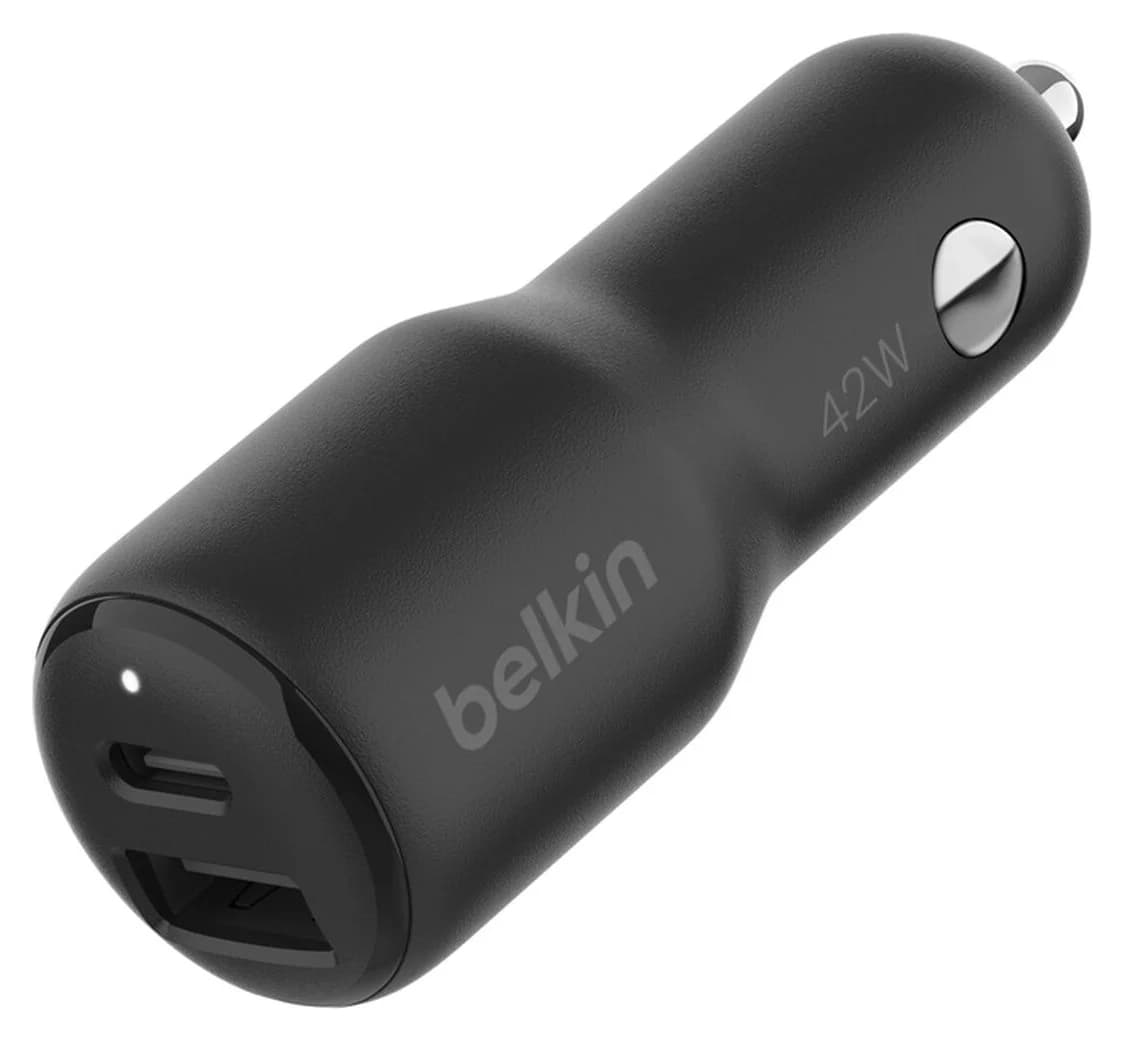
Belkin BoostCharge Dual Car Charger 42W (USB-C 30W PD/PPS + USB-A 12W, Black)30W max output · 2 ports
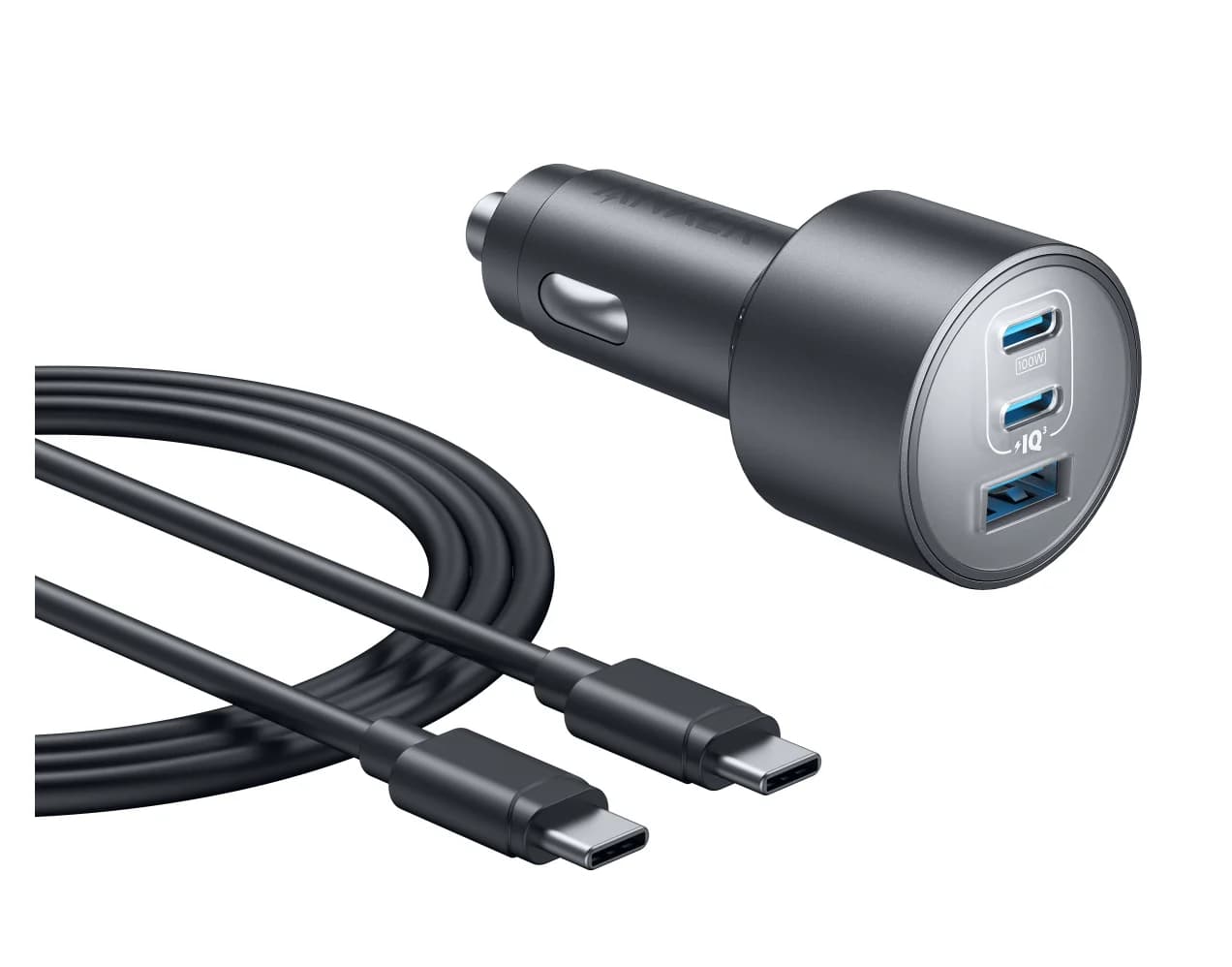
If you want one car charger that handles a laptop and a phone at once, get the Anker Nano Car Charger (167.5W, 3 Ports). Its main USB-C port does 100W, enough for a MacBook Air or a 14-inch MacBook Pro, and Anker says it keeps that 100W while the other two ports are busy. If you'd rather not keep a cable in the car, the UGREEN Nexode 145W has a retractable cable built in.
The wattage printed on a car charger is a total, and most of them split it once a second device plugs in. This guide lists what each port delivers, taken from the manufacturers' spec sheets and manuals. We haven't physically tested these chargers.
Quick picks
| Pick | Award | Outputs | Best single output | Everything plugged in | 24V trucks |
|---|---|---|---|---|---|
| Anker Nano Car Charger (167.5W) | Best overall | 2x USB-C, 1x USB-A | 100W | 100W + 45W + 22.5W | Yes |
| UGREEN Nexode 145W Retractable | Best built-in cable for laptops | Cable, 2x USB-C, 1x USB-A | 100W | 65W + 45W + 7.5W + 7.5W | Yes |
| Spigen ArcStation Essential 113W | Best for Samsung Galaxy phones | 2x USB-C, 1x USB-A | 65W | 65W + 30W + 18W | Yes |
| Anker Nano Car Charger (75W) | Best built-in cable for phones | Cable, 1x USB-C | 45W | 45W + 30W | Yes |
| Belkin BoostCharge Dual 42W | Best compact phone charger | 1x USB-C, 1x USB-A | 30W | 30W + 12W | Yes |
How much power do you need?
| Device | What to look for on one port |
|---|---|
| iPhone 15 and 16 | 20W to 30W USB PD |
| iPhone 17 | 40W USB PD for Apple's fastest figure |
| Galaxy S26+, Pixel 11 Pro XL | 45W USB PD with PPS |
| iPad and other tablets | 30W to 45W |
| MacBook Air, thin Windows laptops | 45W to 70W |
| 14-inch MacBook Pro, performance laptops | 100W |
USB Power Delivery (PD) is the standard almost every USB-C phone and laptop uses. PPS (Programmable Power Supply) is a PD extension that lets the phone request voltage in small steps, and Samsung and Google rely on it for their fastest modes. A charger with PD but no PPS still charges a Galaxy or Pixel, just more slowly. Our fast-charging phones guide covers what each current phone asks for.
Best overall: Anker Nano Car Charger (167.5W, 3 Ports)
Anker
Anker Nano Car Charger (167.5W, 3 Ports)
A three-port car charger with a 100W USB-C port, a 45W USB-C port and a 22.5W USB-A port, rated for 12V and 24V vehicle sockets, with a 3.3 ft USB-C cable in the box.
- 100W max output
- 3 ports
This is the car charger most people should buy, because it's one of the few that doesn't make you choose between the laptop and the phone. Anker's quick start guide lists the ports like this:
| Port | Output | Max |
|---|---|---|
| USB-C1 | 5V/3A, 9V/3A, 15V/3A, 20V/5A | 100W |
| USB-C2 | 5V/3A, 9V/3A, 5-11V/5A | 45W |
| USB-A | 5V/3A, 9V/2A, 10V/2.25A | 22.5W |
| Two ports in use | Each keeps its own rating | Up to 145W |
| All three in use | 100W + 45W + 22.5W | 167.5W |
That 20V/5A profile on USB-C1 covers a MacBook Air, a 14-inch MacBook Pro and most USB-C Windows laptops. Anker quotes a 16-inch MacBook Pro going from 0 to 50% in 47 minutes on it, which is slower than that laptop's 140W maximum but useful on a long drive. USB-C2 is aimed at phones, and Anker names the Galaxy S23 Ultra and S24 Ultra as its targets.
It's rated for both 12V and 24V sockets, measures 3.16 x 1.42 x 1.42 inches, and comes with a 3.3 ft USB-C cable and an 18-month warranty. One gap: Anker doesn't state the included cable's wattage, and 100W needs a 5A e-marked cable. If your laptop charges slowly, try a cable marked 100W or 240W.
See the Anker Nano Car Charger (167.5W) on Amazon
Best built-in cable for laptops: UGREEN Nexode Car Charger 145W
UGREEN
UGREEN Nexode Car Charger 145W with Retractable USB-C Cable
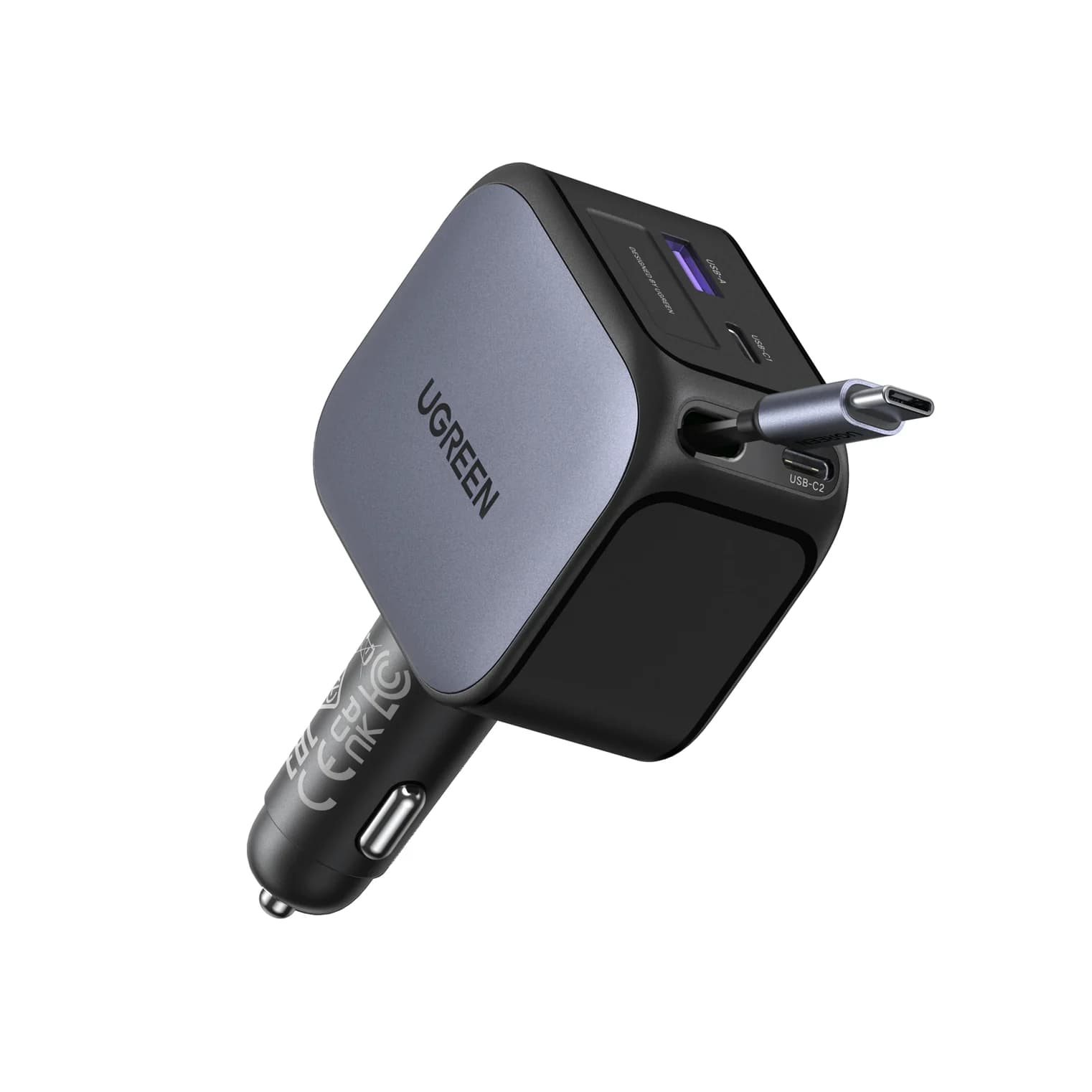
A 145W car charger with a built-in 70cm retractable USB-C cable plus two USB-C ports and a USB-A port, rated for 12V and 24V vehicles.
- 100W max output
- 4 ports
A retractable cable solves the most common car-charging problem: the cable that's never there when you need it. UGREEN's is the only one here whose cable reaches 60W. The cable alone supplies up to 60W at 20V/3A, and it pulls out to 0.7m with eight preset lengths.
| Output | Alone | Cable + USB-C2 | All four in use |
|---|---|---|---|
| Retractable cable | 60W | 45W | 45W |
| USB-C2 | 100W | 100W | 65W |
| USB-C1 | 30W | Not in use | 7.5W |
| USB-A | 30W | Not in use | 7.5W |
So a laptop can take the full 100W from USB-C2 while a phone or MacBook Air charges at 45W on the cable. The weak spot is four devices at once: the two smaller ports fall to 7.5W each, which is trickle speed for a phone. UGREEN publishes only those two combinations, so pairs like the cable plus USB-C1 aren't documented.
USB-C2 has the widest PPS range in this guide, 5-21V at up to 5A. On paper that covers the voltage and current Samsung's own 60W adapter lists for the Galaxy S26 Ultra, but UGREEN doesn't name that phone, so treat 60W as unconfirmed. Input is rated for 12V to 24V at up to 17.8A, and the warranty is two years.
See the UGREEN Nexode 145W Car Charger on Amazon
Best for Samsung Galaxy phones: Spigen ArcStation Essential 113W
Spigen
Spigen ArcStation Essential 113W USB-C Car Charger (EV1133)
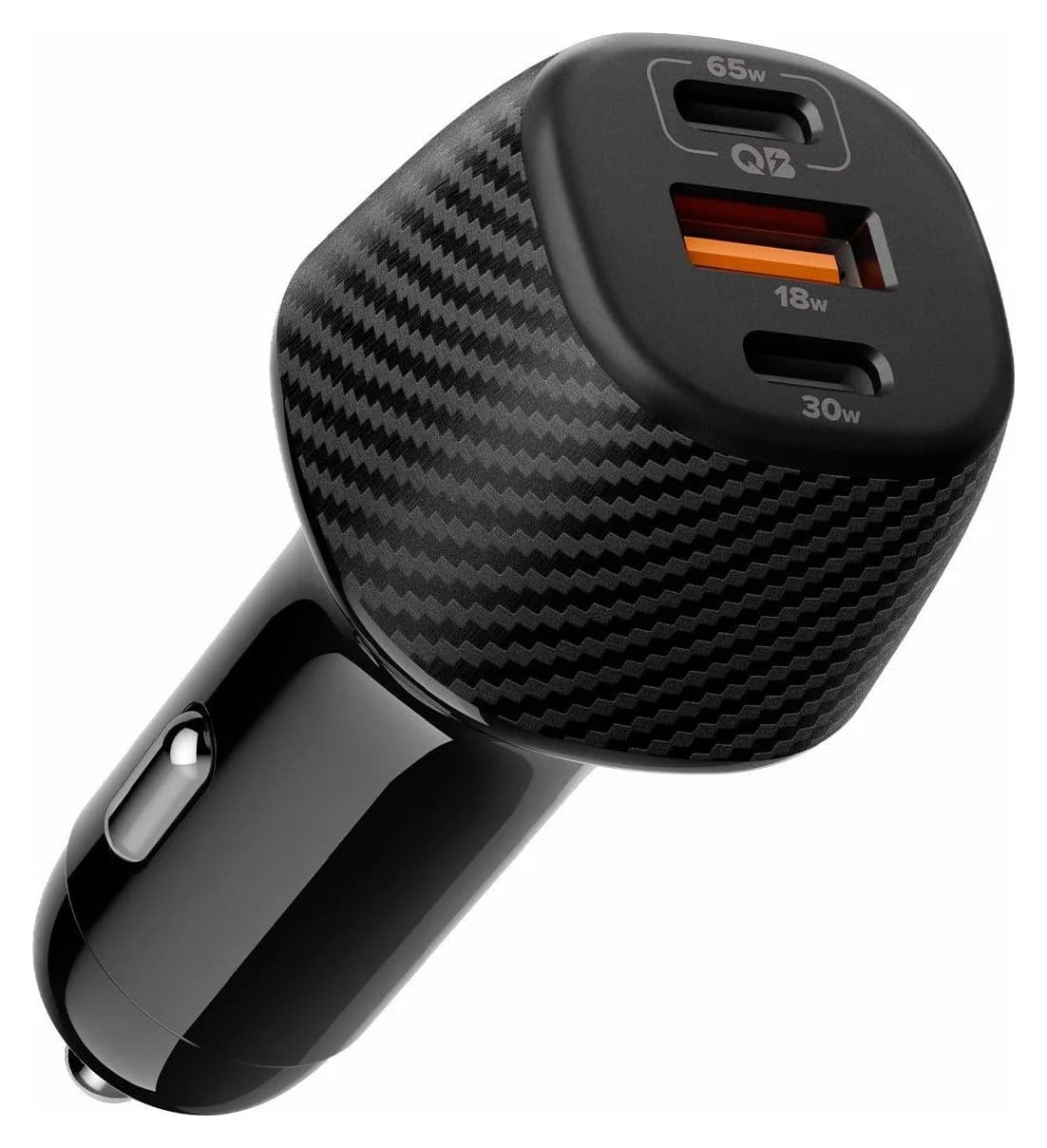
A compact three-port car charger with a 65W USB-C port, a 30W USB-C port and an 18W USB-A port, sold with a 1m 100W USB-C cable.
- 65W max output
- 3 ports
Spigen spells out Samsung support on both USB-C ports. USB-C1 delivers up to 65W over USB PD and supports Samsung's 45W Super Fast Charging 2.0 via PPS. USB-C2 delivers up to 30W and supports Samsung's 25W Super Fast Charging. The USB-A port adds 18W of Quick Charge. Spigen rates all three running together at 65W + 30W + 18W, for 113W total.
That makes it a good family-car charger: two Galaxy phones at their PPS rates, or a MacBook Air on USB-C1 and a phone on USB-C2. Spigen quotes a 13-inch M3 MacBook Air reaching 51% in 30 minutes. It's a small charger at 1.41 x 1.41 x 2.95 inches and 1.5 oz, and it's rated for 12V to 24V vehicles.
It's also the only pick that includes a separate cable rated for 100W: a 1m USB-C cable with an e-marker. The limits are that 65W is below what a 14-inch MacBook Pro uses at full speed, and Spigen doesn't publish a separate two-port table.
See the Spigen ArcStation Essential 113W on Amazon
Best built-in cable for phones: Anker Nano Car Charger (75W, Retractable)
Anker
Anker Nano Car Charger (75W, Built-In Retractable USB-C Cable, Gray)
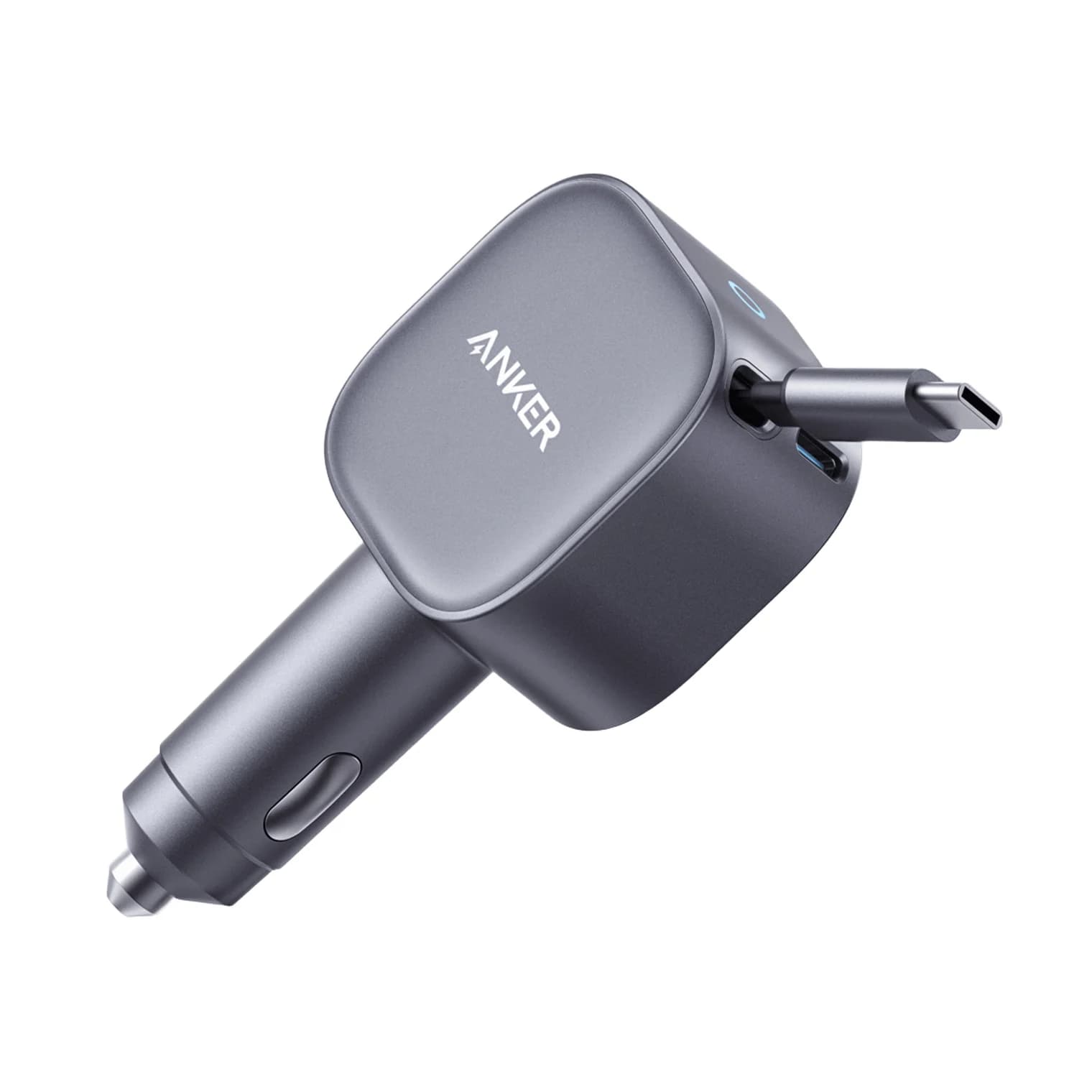
A two-output car charger with a built-in 29.5-inch retractable USB-C cable rated at 45W plus a separate 30W USB-C port, for 75W total from a 12V or 24V socket.
- 45W max output
- 2 ports
If you mainly charge phones and a tablet, this Anker is the simpler retractable option. Its quick start guide lists two outputs:
| Output | Max | Notes |
|---|---|---|
| Retractable USB-C cable | 45W | 5V to 20V (20V/2.25A), plus a 5-11V/3A range |
| USB-C port | 30W | 5V to 15V, plus a 5-11V/3A range |
| Both in use | 45W + 30W | No power sharing |
45W covers the iPhone 17's 40W fast-charge figure, and it's enough to top up a MacBook Air, though not at Apple's 70W fast-charge rate. Anker quotes an iPhone 15 Pro reaching 50% in 25 minutes. The cable extends to 75cm (29.5 inches) and retracts with a short tug. Input is rated for 12V and 24V, and the warranty is 18 months.
Anker's own UK page warns that if your socket sits behind the center console or under a seat, the cable may not reach. Check the distance before you buy. And as with any built-in cable, if it frays, you replace the whole charger.
See the Anker Nano Car Charger (75W) on Amazon
Best compact phone charger: Belkin BoostCharge Dual Car Charger 42W
Belkin
Belkin BoostCharge Dual Car Charger 42W (USB-C 30W PD/PPS + USB-A 12W, Black)
A compact two-port car charger with a 30W USB-C Power Delivery port with PPS and a 12W USB-A port, rated for 12V to 24V DC.
- 30W max output
- 2 ports
Not every car needs a laptop charger. Belkin's 42W dual charger is a small, plain option for one phone and one accessory, and it's USB-IF certified and USB PD 3.0 certified, according to Belkin. Its FAQ lists the USB-C port at 5V/3A, 9V/3A, 12V/2.5A and 15V/2A, plus PPS from 3.3 to 11V at 3A, for 30W. The USB-A port adds 12W, and both run together for 42W.
Belkin quotes an iPhone 15 Pro going from 0 to 50% in 21 minutes and a Galaxy S23 Ultra in 26 minutes. There's no 20V profile, so it won't charge a laptop properly, and 30W falls short of the 40W Apple uses for the iPhone 17's fastest figure and Samsung's 45W mode. It's rated for 12V to 24V, measures 26mm across and 70mm long, and carries a two-year warranty. The standalone version has no cable. It's also an easy stocking stuffer.
See the Belkin BoostCharge 42W on Amazon
How we choose
We haven't physically tested these chargers. Our picks come from research:
- Manufacturer spec sheets and manuals. Every per-port figure comes from the maker's product page, quick start guide or FAQ. Where a maker doesn't publish a combination, we say so.
- Standards. We check each port against USB Power Delivery: 20V profiles for laptops, 5A cables above 60W, and PPS for Samsung and Google phones.
- Vehicle fit. We only picked chargers rated for both 12V cars and 24V trucks.
- Known buyer patterns. The common complaints are slow laptop charging from power splits and cables, and cables that don't reach the seat.
We also confirm each Amazon listing matches the maker's model. We looked at the Baseus PrimeTrip VR2 Max, which is sold as a 240W charger, but Baseus's own table never adds up to more than 123W at once, and its US product page doesn't state an input voltage range.
Buying guide
Read the split, not the total. A car charger's headline figure is the most it can deliver across all ports, or sometimes just the single-port maximums added up. What matters is the port your laptop or phone uses, with everything else plugged in. The two Ankers keep each port at full rating. The UGREEN and Spigen document their splits.
Laptops need 20V and a 5A cable. A port has to offer a 20V USB PD profile to charge most laptops properly, and above 60W you need a 5A e-marked cable. Apple quotes fast charging for the MacBook Air at 70W or more and the 14-inch MacBook Pro with M5 Pro at 96W or more. No car charger here reaches the 16-inch model's 140W. Our fast-charging cable guide explains cable markings.
12V cars, 24V trucks. Passenger cars run on 12V, while many heavy trucks and buses use 24V. All five picks are rated for both. A charger that doesn't list 24V shouldn't go in a 24V vehicle.
Check the socket. High-wattage chargers draw a lot of current. Anker's manual lists the 167.5W model's input as 12V at 18.2A, and UGREEN lists up to 17.8A for its 145W charger. Your owner's manual gives the socket's fuse rating, so check it before you run several devices at full power. In many cars the socket also switches off with the ignition.
Built-in or separate cable. A retractable cable can't be forgotten or lost, but it has a fixed length and can't be swapped if it fails. A separate cable is replaceable and can be longer for back-seat passengers.
No socket to spare? A USB-C power bank charges in the car and keeps going after you park. See our power bank guide, and our USB-C charger guide for wall chargers.
Verdict
For most drivers, the Anker Nano Car Charger (167.5W) is the one to buy: 100W for a laptop, 45W for a phone and a USB-A port, with no power sharing. Pick the UGREEN Nexode 145W if you want a retractable cable that can charge a laptop, or the Spigen ArcStation Essential 113W if your household runs on Galaxy phones. The Anker 75W is the tidy built-in-cable choice for phones, and the Belkin 42W is the small, simple pick for one phone and an accessory.
Frequently asked questions
Can a USB-C car charger charge a laptop?
Yes, if one of its USB-C ports supplies 20V USB Power Delivery at a high enough wattage. Apple quotes MacBook Air fast charging at 70W or more and the 14-inch MacBook Pro with M5 Pro at 96W or more, so a 100W port covers both. Above 60W you also need a 5A e-marked cable. In many cars the socket switches off with the ignition, so the laptop only charges while the car is on.
Will a car charger work in a 24V truck?
Only if the maker rates it for 24V input. Passenger cars use 12V, but many heavy trucks and buses use 24V. All five picks in this guide are rated for both: Anker lists 12V and 24V input for its two chargers, and UGREEN, Spigen and Belkin list 12V to 24V. If a charger's spec sheet doesn't mention 24V, don't use it in a 24V vehicle.
Do I need a PPS car charger for my Samsung or Pixel?
For full speed, yes. Samsung's Super Fast Charging and Google's 45W Pixel charging both use PPS, an extension of USB Power Delivery. A charger without PPS still charges these phones, but at a slower fallback rate. iPhones use standard USB PD, so PPS doesn't matter for them. Check which port has PPS, because on multi-port car chargers it's often only one or two.
Why does my laptop charge slowly from a high-wattage car charger?
Usually one of four things. The total on the box is shared across ports, so your laptop's port may get less once a phone plugs in. A standard 3A USB-C cable caps charging at 60W. The laptop may want more than the port offers, as a 16-inch MacBook Pro does. Or the charger is plugged into a socket that can't supply full current.
What does the total wattage on a car charger actually mean?
It's usually the most the charger can deliver across all its ports, and sometimes just the single-port maximums added together. No one device gets the total. Look for the maker's per-port table: the wattage of the port your laptop or phone uses, with everything else plugged in, is the number that matters.
Related guides
Best Samsung Galaxy Charger in 2026: 25W, 45W and 60W Super Fast Charging Explained
The right charger for your Galaxy phone or tablet from Samsung's specs: 25W, 45W or 60W, the PPS range and 5A cable behind it, plus Watch, Buds and Pixel tips.
Updated October 22, 2026Read
How to Spot a Real USB-C Deal: A Black Friday Buyer's Guide for 2026
Spot fake-capacity drives, 240W cables with no e-marker, padded charger wattage, uncertified Qi2 and counterfeit sellers before you buy this Black Friday.
Updated October 22, 2026Read
USB Power Delivery Explained: PD 3.1, PPS, AVS and 240W Charging
How USB-C Power Delivery works: fixed voltages, PPS for Galaxy and Pixel, AVS for iPhone 18 Pro, 240W EPR, why bigger chargers are safe, and port sharing.
Updated October 22, 2026Read