Black Friday: the specs to check before you buy
Comparison
Samsung T9 vs SanDisk Extreme V2: Which 2TB External SSD for Gaming?
Samsung T9 vs SanDisk Extreme V2 at 2TB, from the makers' own spec pages: real speeds on gaming laptops, Steam Deck, PS5 and Xbox, included cables, and which to buy.
By thisUSB EditorialUpdated November 5, 202613 min read2 picks
Our picks at a glance
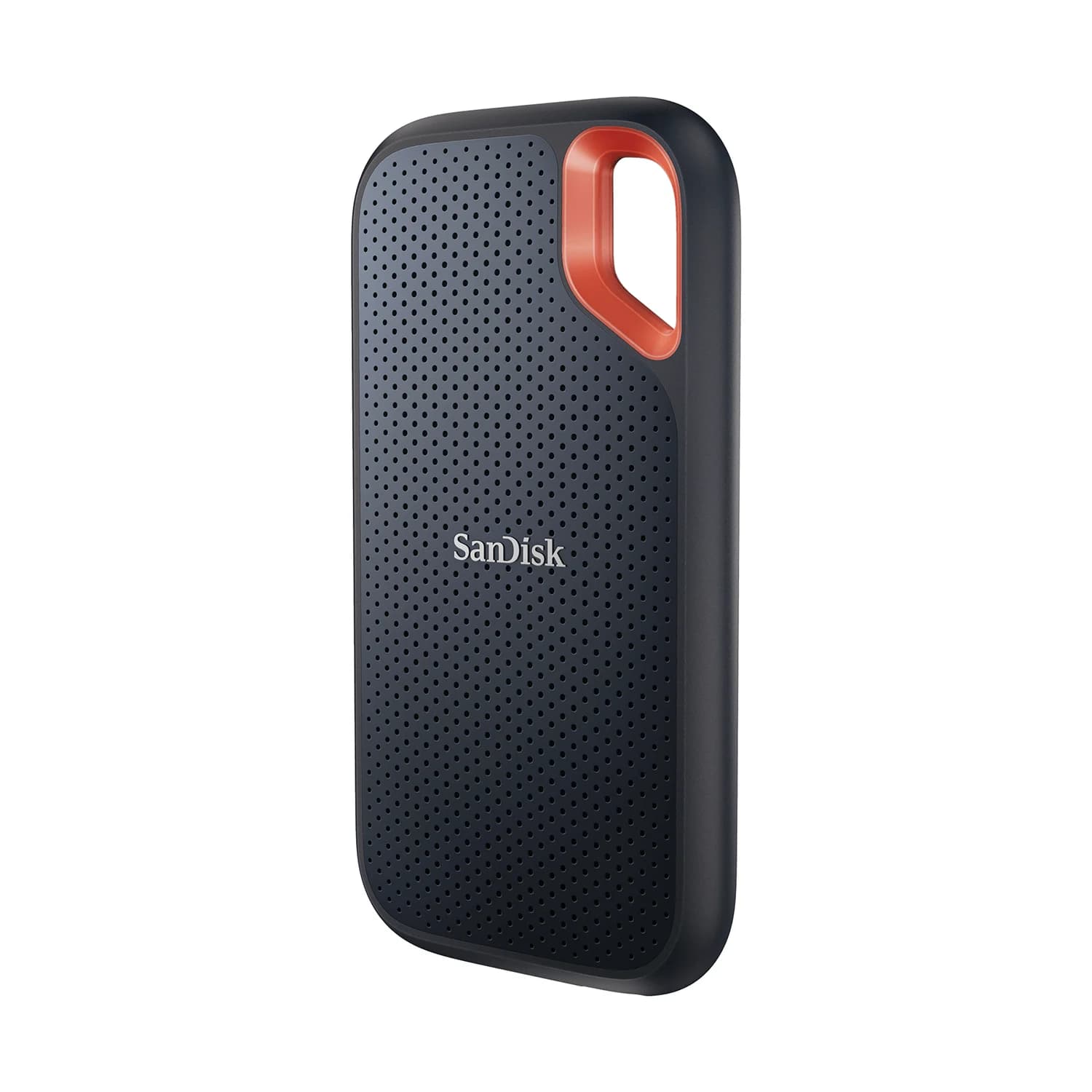
Best for Steam Deck, PS5, Xbox and every 10Gbps portSanDisk
SanDisk Extreme Portable SSD (2TB, V2)
- data
- 10 Gbps
- port
- 1
- host link
- USB-C
- Choose
- The SanDisk Extreme V2's USB 3.2 Gen 2 interface matches every gaming console's actual port limit, and its IP65 rating suits bag-and-couch duty. SanDisk's newer Extreme generation is faster, so check the model before buying.
- Limit
- 10Gbps interface tops out around 1,050MB/s
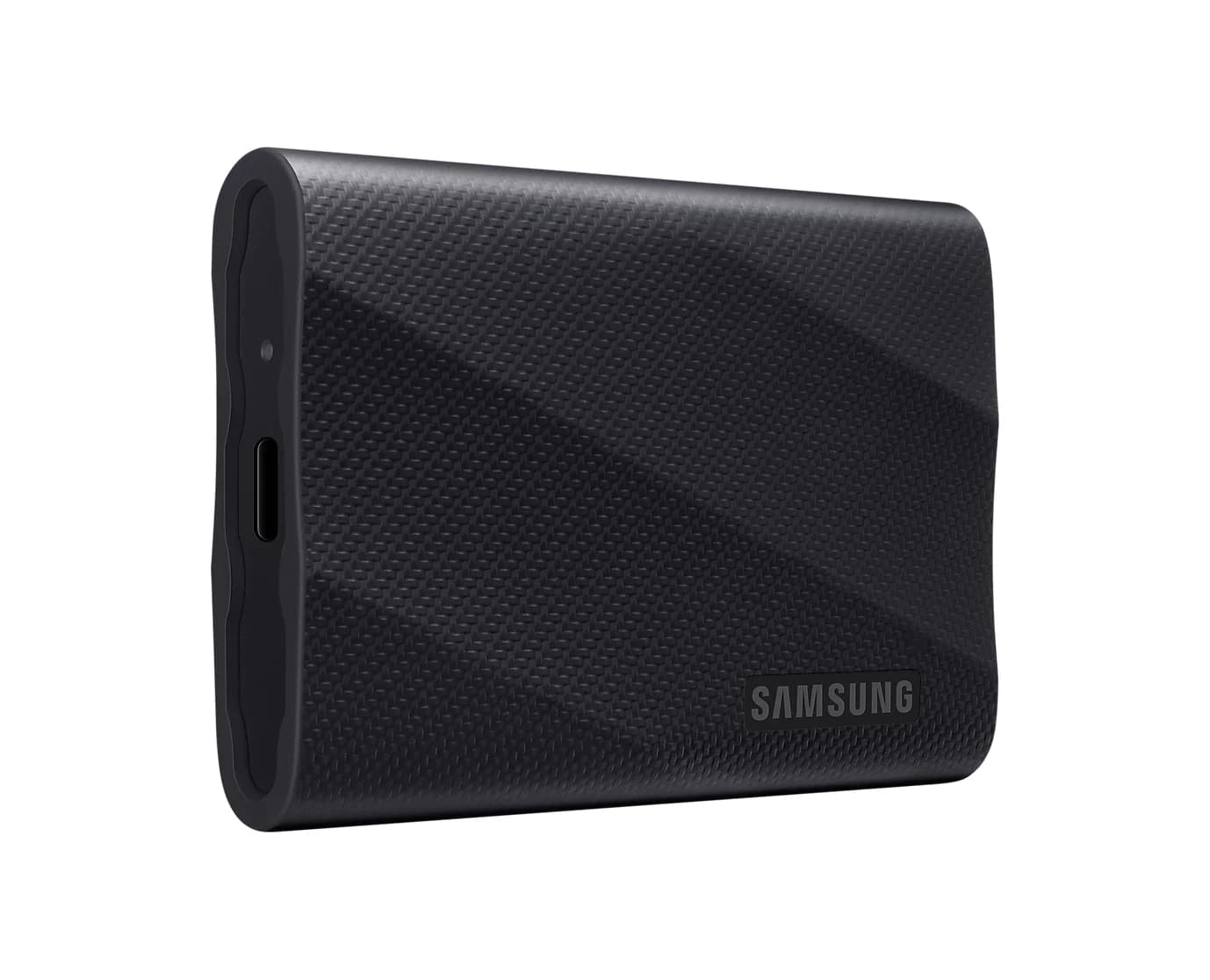
Samsung T9 2TB
If your gaming laptop has a USB 3.2 Gen 2x2 or USB4 port, buy the Samsung Portable SSD T9 2TB: its 20Gbps interface is rated up to 2,000 MB/s read, double the ceiling of a 10Gbps drive, and both a USB-C to C and a USB-C to A cable come in the box. If you play on a Steam Deck, PS5 or Xbox, or your laptop's fastest port is plain USB 3.2 Gen 2, buy the SanDisk Extreme Portable SSD V2 2TB: its 1050MB/s rating already saturates every one of those ports, and its IP65 water-and-dust rating suits the bag-and-couch life. One generation note: Sandisk has since released a faster next-generation Extreme Portable SSD, while this page deliberately compares the older V2. The honest rule: match the drive and generation to your device's actual port, not to the bigger headline number.
- 2,000 MB/sSamsung T9 rated read speed, on a USB 3.2 Gen 2x2 or USB4 host with a Gen 2x2 cable
- 1050 MB/sSanDisk Extreme V2 rated read speed, which saturates every 10Gbps console and Deck port
- 2,000 MB/sThe newer SanDisk Extreme Portable SSD rated read speed; the V2 here is the previous generation
- 2TBThe matched capacity compared here; the T9 is current-generation, while the Extreme V2 is previous-generation
Quick picks
| Pick | Best for | The one-line case |
|---|---|---|
| Samsung T9 2TB | Gaming laptops with Gen 2x2 or USB4; moving huge game libraries fast | Up to 2,000 MB/s read over USB 3.2 Gen 2x2, both C-to-C and C-to-A cables included |
| SanDisk Extreme V2 2TB | Steam Deck, PS5, Xbox, and any 10Gbps-only laptop | 1050MB/s over USB 3.2 Gen 2, IP65-rated, USB-C to A adapter included; a newer Extreme generation is faster |
Which one for your gaming device?
| Your device | Our pick | Why |
|---|---|---|
| Gaming laptop with USB4 or USB 3.2 Gen 2x2 | Samsung T9 2TB | Only a 20Gbps-capable port feeds the T9 its rated speed |
| Gaming laptop with 10Gbps USB-C only | SanDisk Extreme V2 2TB | A Gen 2x2 drive adds nothing here; both drives top out at the port's limit |
| Steam Deck | SanDisk Extreme V2 2TB | Valve lists the Deck LCD's USB-C external connectivity as USB 3.2 Gen 2 |
| PS5 | SanDisk Extreme V2 2TB | The PS5's USB ports are SuperSpeed USB 10Gbps, and Sony runs Gen 2x2 drives at 10Gbps anyway |
| Xbox Series X|S | Either drive | Xbox requires USB 3.0/3.1 and 128 GB or more; both clear it with room to spare |
The exact drives compared: generations, specs and warranty
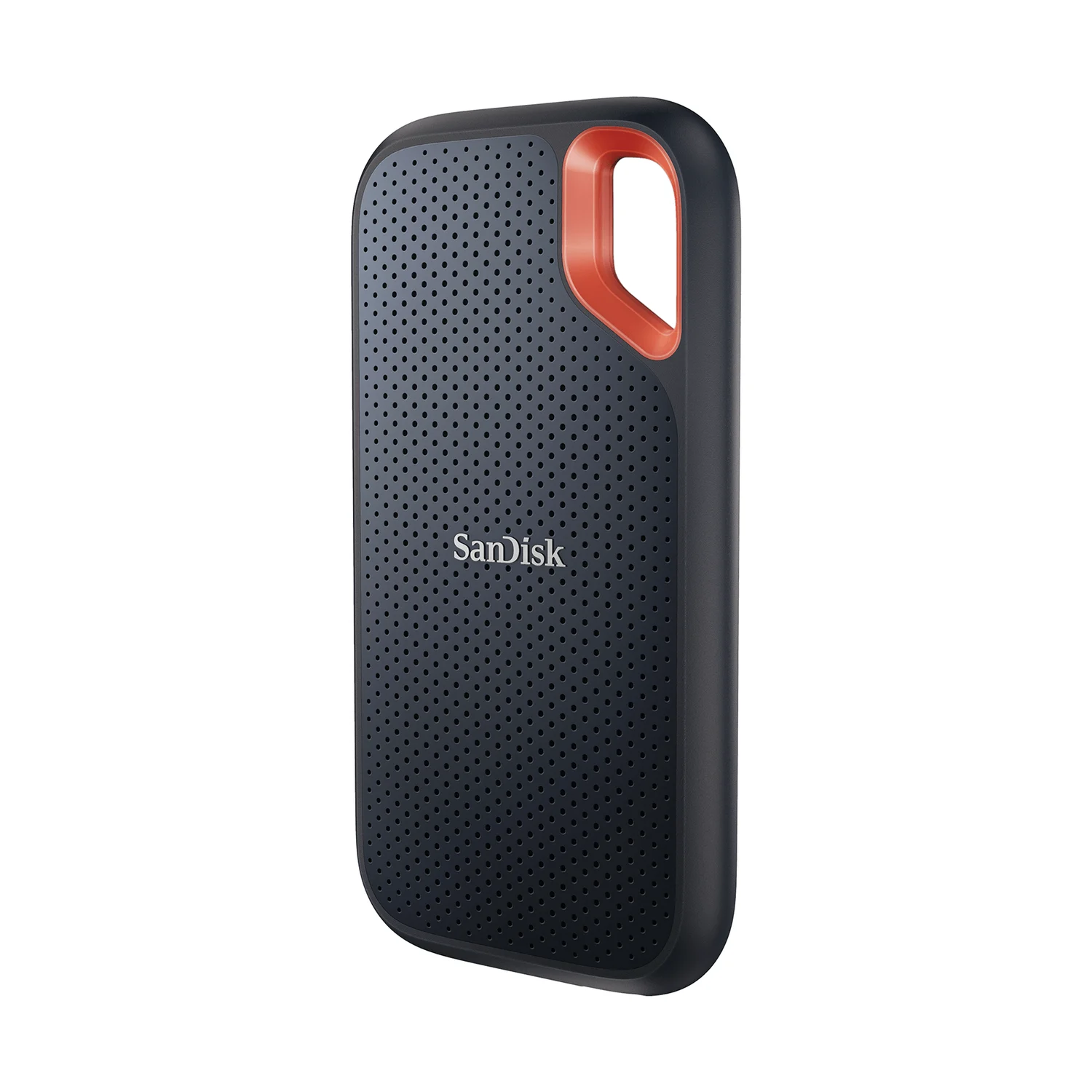
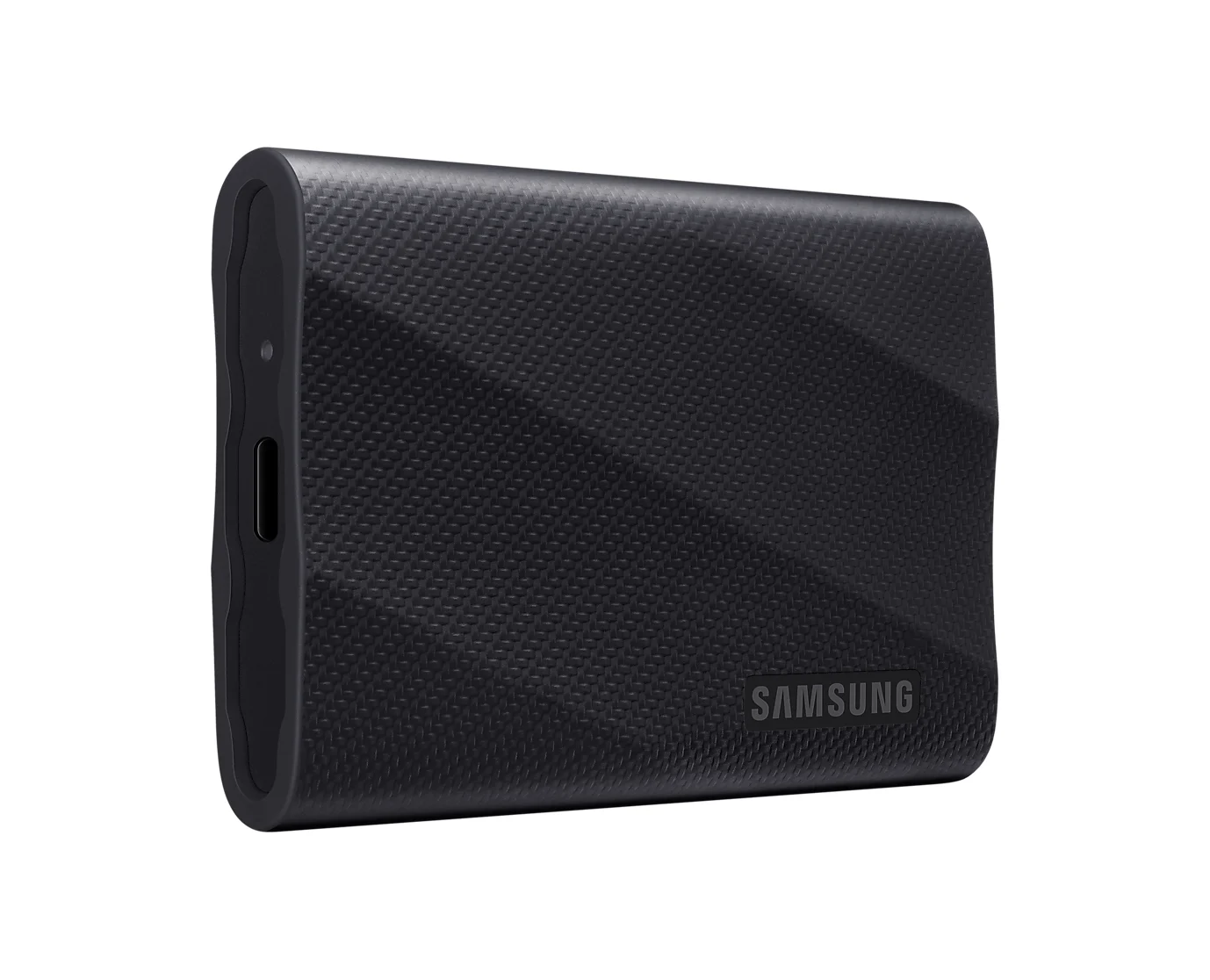
This page compares the current Samsung T9 against the previous-generation SanDisk Extreme V2 at the same 2TB capacity, so it is not a straight same-generation comparison. Samsung's T9 is USB 3.2 Gen 2x2 (20Gbps) with NVMe performance; SanDisk's Extreme V2 is USB 3.2 Gen 2. Samsung sells the T9 at 1TB, 2TB and 4TB. SanDisk's current Extreme Portable SSD page lists 500GB, 1TB, 2TB and 4TB models, while its press release says 1TB, 2TB and 4TB are available now; the 8TB tier belongs to the separate Extreme PRO line.
| Specification | Samsung T9 (2TB) | SanDisk Extreme V2 (2TB) |
|---|---|---|
| Interface | USB 3.2 Gen 2x2 (20Gbps) | USB 3.2 Gen 2 |
| Sequential read | Up to 2,000 MB/s | 1050MB/s |
| Sequential write | Up to 1,950 MB/s on Samsung's UK spec page (its US page headlines 2,000 MB/s) | 1000MB/s |
| Encryption | AES 256-bit hardware | 256-bit AES hardware |
| Drop resistance | Up to 3-meter (9.8 ft on Samsung's US page) | Up to three-meter |
| Water/dust rating | Not claimed on Samsung's pages | IP65 water and dust resistance |
| Weight | 122 g | Silicone shell; dimensions in SanDisk's spec table |
| In the box | USB-C to C and USB-C to A cables | V2: USB-C to USB-C cable and USB-C to USB-A adapter; current Extreme: USB-C to USB-C cable and guide |
| Warranty | 5-year limited | 5-year limited |
One honest note on the T9's write number: Samsung's US product page headlines "2,000MB/s Read | 2,000MB/s Write", while the UK page's spec table lists sequential write at up to 1,950 MB/s. We show both rather than picking one. The US highlights also state the same 9.8 ft drop rating the UK page calls 3-meter.
Gaming laptop and Steam Deck: host ports decide your real speed
The T9's 2,000 MB/s rating comes with conditions Samsung prints as a footnote: to reach maximum speed, the host device and connection cables must support USB 3.2 Gen 2x2 and the UASP mode must be enabled. Plug it into a 10Gbps port and it negotiates down, as you'd expect, since Samsung says the T9 is backward compatible with USB 3.2, USB 3.1, USB 3.0 and USB 2.0.
That matters because most portable gaming hardware tops out at 10Gbps. Valve's Steam Deck LCD spec page lists USB-C external connectivity as USB 3.2 Gen 2, the 10Gbps tier, alongside DisplayPort output up to 8K @60Hz or 4K @120Hz. On a Deck, the T9 and the Extreme V2 run against the same port ceiling, and the Gen 2x2 drive's speed advantage evaporates. A gaming laptop is different only if it has a USB4, Thunderbolt or USB 3.2 Gen 2x2 port; there, the T9's interface can actually be fed. Samsung says the T9 can transfer a 2GB file in almost 1 second through its Gen 2x2 interface on a qualifying host, which is the kind of gap that shows up when you are moving whole game installs back and forth.
Source: Samsung and SanDisk product pages, Valve's Steam Deck tech specs and Sony's PS5 extended-storage page
PS5 and Xbox: storage rules both drives clear, with one shared catch
Sony's PS5 extended-storage page sets the bar: SuperSpeed USB 5 Gbps or later, 250 GB minimum and 8 TB maximum capacity, no USB hubs, and one extended-storage drive at a time. Both drives clear every line at 2TB, and both connect to the PS5's USB Type-C or USB Type-A ports, which Sony rates at SuperSpeed USB 10Gbps.
The catch Sony also prints: a PS5 footnote says USB 3.2 Gen2x2 devices are supported but run as single-lane USB 3.2 x1 connections at 10Gbps. So the T9's headline interface buys you nothing on a PS5; it behaves like a 10Gbps drive. And no PS5 game plays from USB at all: PlayStation 5 games can't be played directly from USB extended storage, so you copy game data back to console storage to play. PS4 games do run directly from the drive, and you can even set the drive as the installation location for PS4 games.
Xbox rules are looser on paper and equally strict for current-gen titles. Microsoft's storage page says a drive for Xbox games and apps must hold 128 GB or more and connect via USB 3.0/3.1; anything less is treated as media storage. Optimized for Xbox Series X|S games must be installed on the internal SSD or the Storage Expansion Card, but you can store them on the external drive and transfer them back when you want to play, which saves re-downloading large game files.
- Yes: PS4 games play directly from either drive on a PS5
- Yes: Non-Optimized Xbox games play directly from either drive on Xbox
- Yes: Both drives meet PS5 requirements: SuperSpeed USB 5 Gbps or later, 250 GB to 8 TB
- Yes: Both drives meet Xbox requirements: 128 GB or more, USB 3.0/3.1
- Partly: PS5 games: store and transfer, but copy back to console storage to play
- Partly: Optimized Xbox Series X|S games: store and transfer, but play only from internal SSD or Storage Expansion Card
- No: No PS5 Gen 2x2 speed gain: Sony runs Gen2x2 drives at 10Gbps
Best for a gaming laptop with Gen 2x2 or USB4: Samsung Portable SSD T9 (2TB)
The T9 is the drive you buy for the host you already own only if that host can feed it. Samsung rates the USB 3.2 Gen 2x2 (20Gbps) interface at up to 2,000 MB/s sequential read, with the UK spec page listing sequential write at up to 1,950 MB/s and the US page headlining 2,000 MB/s write. Samsung's fine print says both host and cable must support Gen 2x2 with UASP enabled to get there, so pair it with the included cables and a matching port.
The rest of the package is travel-ready: drop resistance up to 3-meter (9.8 ft on Samsung's US page), Dynamic Thermal Guard, AES 256-bit hardware encryption, an IEC 62368-1 safety-standard design, 122 g of weight, and Samsung Magician software for firmware updates and drive health on Windows 7+, macOS High Sierra 10.13.6+ or Android 5.1+. Samsung lists its compatible devices as PCs, laptops, Android smartphones and tablets, game consoles, smart TVs and cameras. Where it does not win: it has no water-resistance claim against the Extreme V2's IP65, and on every 10Gbps port it runs at the port's limit like any Gen 2 drive.
See the Samsung T9 2TB on Amazon
Best for Steam Deck, PS5, Xbox and every 10Gbps port: SanDisk Extreme V2 (2TB)
SanDisk
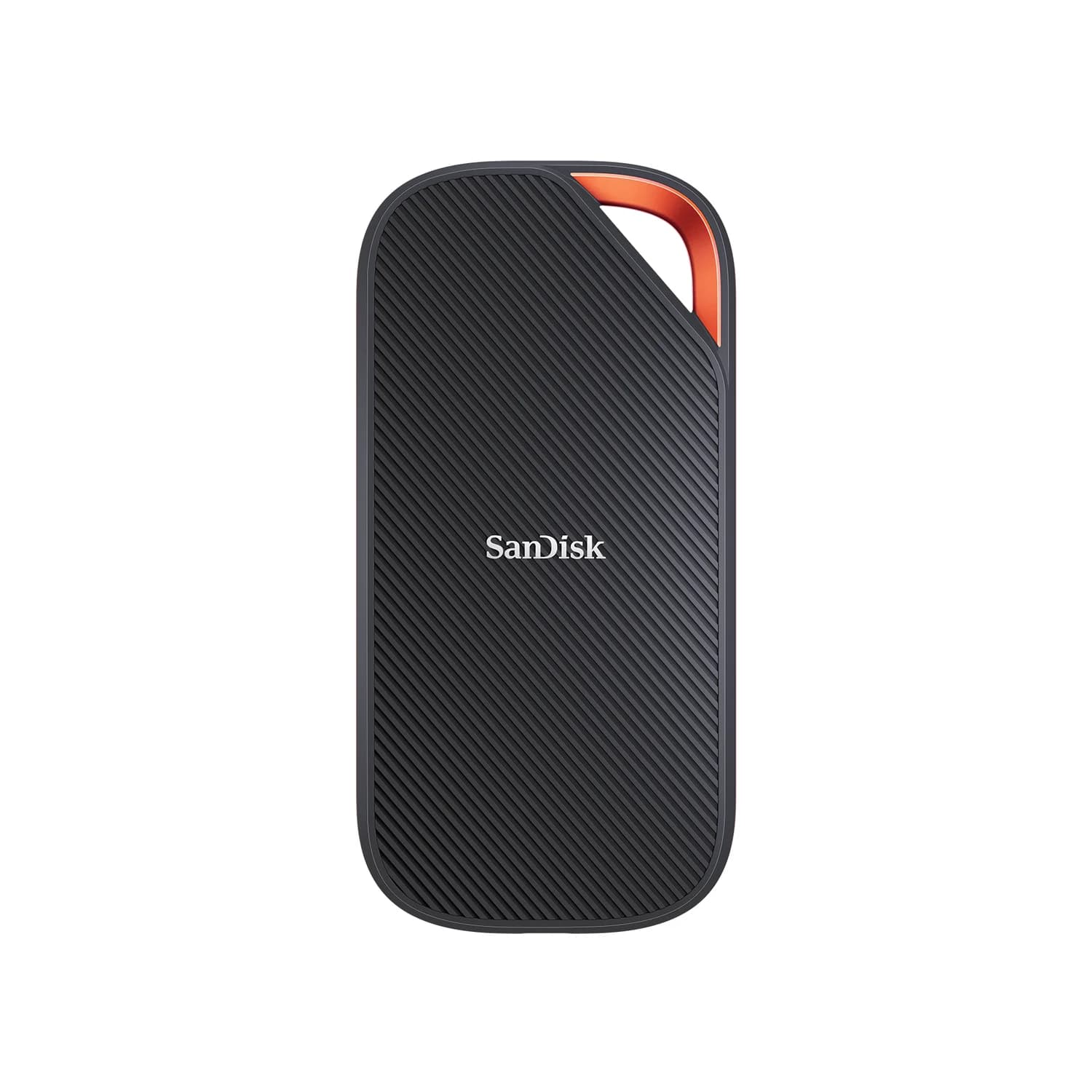
SanDisk Extreme Portable SSD (2TB, V2)
A pocket-size 2TB NVMe portable SSD over USB 3.2 Gen 2 with IP65 water and dust resistance and a carabiner loop.
- 10 Gbps data
- 1 port
The Extreme V2 is the drive that matches how consoles and handhelds actually connect. Its USB 3.2 Gen 2 interface is rated at 1050MB/s read and 1000MB/s write, which saturates the PS5's SuperSpeed USB 10Gbps ports, Valve's USB 3.2 Gen 2 Steam Deck port and every USB 3.0/3.1 Xbox port. Sony runs Gen 2x2 drives at 10Gbps anyway, so paying for the bigger interface buys nothing on a console. SanDisk's current 2TB Extreme Portable SSD is faster, but on these 10Gbps consoles the port remains the limit.
Its durability story goes past drops: up to three-meter drop protection plus IP65 water and dust resistance in a silicone shell, with 256-bit AES hardware encryption in the included password protection, and a 5-year limited warranty. In the box are a USB-C to USB-C cable and a USB-C to USB-A adapter, covering consoles' USB-A ports; SanDisk's current Extreme instead lists only the drive, USB-C to USB-C cable and quick install and warranty guide, so Xbox USB-A needs an additional adapter or cable. SanDisk lists current Extreme compatibility as Android 10+, iPadOS 15+, macOS 12+, Windows 10+ and the Files app for iOS 17+, and says its password protection is supported on Windows 10+ and macOS 12+. Where it does not win: on a laptop with Gen 2x2 or USB4, its interface tops out below the T9's rated speed.
See the SanDisk Extreme V2 2TB on Amazon
Ruggedness, support and firmware from primary sources
Both makers publish their own durability and support stories, and both back the drives with 5-year limited warranties. SanDisk claims up to three-meter drop protection, IP65 water and dust resistance, and a durable silicone shell, plus 256-bit AES hardware encryption in the included password-protection software. Samsung claims drop resistance up to 3-meter, Dynamic Thermal Guard to minimize performance drops from overheating, AES 256-bit hardware encryption, and design compliance with the IEC 62368-1 safety standard, with skin temperatures kept below 60ºC in Samsung's controlled heat tests.
Software support splits by platform. Samsung's Magician software provides firmware updates, drive health monitoring and optimization, and runs on Windows 7 and higher, macOS High Sierra 10.13.6 and higher, or Android 5.1 and higher. SanDisk's current page describes the SANDISK app as available for mobile and desktop to manage, back up and transfer files; its compatibility note says password protection is supported by Windows 10+ and macOS v12+. Samsung's UK page lists the T9's compatible devices as PCs, laptops, Android smartphones and tablets, game consoles, smart TVs and cameras.
If firmware updates matter to you, Samsung clearly documents Magician's Windows and macOS firmware-update path. SanDisk publishes a desktop-capable SANDISK app, but the current Extreme page does not clearly describe desktop firmware updates, so check SanDisk's support pages for the exact drive and platform.
Complete kits: what a 2TB purchase actually includes
Neither drive here needs an extra purchase to connect to your gear: the T9 ships with a USB-C to C cable and a USB-C to A cable, while the Extreme V2 ships with a USB-C to USB-C cable and a USB-C to USB-A adapter. That covers gaming laptops (USB-C), PS5 (both port types), Xbox (USB-A) and the Steam Deck (USB-C). If you buy SanDisk's current Extreme instead, its listed box contains only the drive, a USB-C to USB-C cable and a quick install and warranty guide, so Xbox USB-A requires an additional adapter or cable.
The one cable worth checking: if you buy the T9 for its 2,000 MB/s rating, remember Samsung's own condition that the connection cable must support USB 3.2 Gen 2x2. The included cables do; a random older USB-C cable from a drawer may not, and would silently cap the drive. Our USB-C cable types explainer shows how to tell them apart.
Black Friday traps: capacity and generation swaps
Deals season is when these two drives get swapped under you. Watch for three traps.
First, capacity swaps: a "Samsung T9 deal" at a lower price is often the 1TB model, and Samsung sells the T9 at 1TB, 2TB and 4TB, while the Extreme V2's 500GB and 1TB variants carry the same name. Compare like capacity with like capacity, which is why this page pins both drives to 2TB.
Second, generation swaps inside the same brand: SanDisk's line also includes the Extreme PRO with a USB 3.2 Gen 2x2 interface, and Samsung's older T7, T7 Shield and T7 Touch are 10Gbps drives. A deal on a "SanDisk Extreme" that turns out to be an older revision or a smaller-capacity V2 is a different purchase. This page compares the current T9 against the previous-generation Extreme V2 at 2TB; SanDisk's current 2TB Extreme uses model SDSSDE70-2T00-G25.
Third, the wrong generation for your console: a Gen 2x2 drive marketed for gaming still runs at 10Gbps on PS5 per Sony's footnote, so paying extra for interface speed you can't use is the classic Black Friday overbuy.
Who should buy a different drive instead
Not everyone should buy either of these. If you own a PS5 and want to actually play PS5 games from external storage, no USB drive does that; the Storage Expansion Card for Xbox Series X|S and the PS5's internal M.2 slot are the upgrade paths for current-gen games, and consoles' own support pages say so. If you carry a drive in a jacket pocket through weather, the Extreme V2's IP65 rating earns its keep and the T9 has no water-resistance claim to match. If your laptop has Thunderbolt or USB4 and you move video projects as well as games, a USB4 portable SSD is a separate tier worth its own comparison. And if you already own a 10Gbps portable SSD in good health, a console or a Steam Deck gives it no reason to upgrade: the port is the limit. For choosing among more drives, our best portable SSD guide covers the wider field.
How we choose
We haven't put either drive on a test bench, and we won't pretend to. Everything on this page comes from primary sources:
- Maker spec pages. Speeds, interfaces, box contents, durability claims and warranties come from Samsung's T9 product pages and SanDisk's Extreme V2 and current Extreme product pages, plus both makers' software pages.
- Console and handheld makers. Port limits, storage requirements and playable-game restrictions come from Sony's PS5 extended-storage page, Microsoft's Xbox storage page, and Valve's Steam Deck tech specs.
- No invented benchmarks. Where the makers disagree (Samsung's two write figures), we show both. Nothing here is a measured result.
Verdict
Buy the Samsung T9 2TB if your gaming laptop has USB 3.2 Gen 2x2 or USB4 and you move large game libraries: up to 2,000 MB/s read on paper, both cables in the box, 3-meter drop resistance and a 5-year warranty. Buy the SanDisk Extreme V2 2TB for a Steam Deck, PS5, Xbox or any 10Gbps host: 1050MB/s read that already saturates those ports, IP65 ruggedness, and the same 5-year warranty. Remember that SanDisk's current Extreme generation is faster and differs in box contents, while the V2 remains sufficient for those 10Gbps ports. On a console, the T9's 20Gbps interface is a spec-sheet number Sony pins to 10Gbps anyway, so the port you own, not the drive's headline, makes this decision.
Frequently asked questions
Is the Samsung T9 or the SanDisk Extreme V2 better for gaming?
It depends on your device's USB ports. The Samsung T9 uses USB 3.2 Gen 2x2 (20Gbps) and is rated up to 2,000 MB/s read, but it only hits that on a gaming laptop with a Gen 2x2 or USB4 port. The SanDisk Extreme V2 uses USB 3.2 Gen 2 (10Gbps) and is rated at 1050MB/s read, which is the ceiling on a Steam Deck, PS5, Xbox or any Gen 2 laptop port anyway. SanDisk's newer Extreme Portable SSD is faster, so this article explicitly compares the older V2. Match the drive and generation to the port, not the headline number.
Can I play PS5 games from an external SSD?
No. Sony's PS5 extended-storage page states PlayStation 5 games can't be played directly from USB extended storage; you copy the game data back to console storage when you want to play. You can play PS4 games directly from the drive, and both the T9 and the Extreme V2 clear Sony's requirements of SuperSpeed USB 5 Gbps or later and 250 GB to 8 TB capacity.
Can I use either drive with an Xbox Series X|S?
Yes, with the same caveat as PS5: Xbox's support page says an external drive for games and apps must hold 128 GB or more and connect via USB 3.0/3.1, which both drives easily meet, but Optimized for Xbox Series X|S titles must be installed on the internal SSD or the Storage Expansion Card. You can store those games externally and transfer them back to play, and non-Optimized games run directly from the drive.
Does the Samsung T9 work at full speed on a Steam Deck?
No, and neither does any Gen 2x2 drive. Valve lists the Steam Deck LCD's USB-C external connectivity as USB 3.2 Gen 2, i.e. 10Gbps, so the T9 drops to about the same practical ceiling as the SanDisk Extreme V2. Samsung also says Gen 2x2 speed needs a host and cable that support USB 3.2 Gen 2x2 with UASP enabled, and the drive is backward compatible with USB 3.2, USB 3.1, USB 3.0 and USB 2.0.
Which cables come in the box with each drive?
Samsung's T9 includes a USB-C to C cable and a USB-C to A cable, so it plugs into old laptop USB-A ports without buying anything. SanDisk's Extreme V2 includes a USB-C to USB-C cable and a USB-C to USB-A adapter; SanDisk's current Extreme Portable SSD instead lists only the drive, a USB-C to USB-C cable and a quick install and warranty guide, so check the listing before assuming an adapter is included.
Are these drives rugged enough to travel with?
Both makers claim 3-meter drop resistance (Samsung's US page lists the same rating as 9.8 ft). The SanDisk adds IP65 water and dust resistance and a silicone shell; the Samsung counters with Dynamic Thermal Guard heat management and an IEC 62368-1 safety-standard design. Neither maker claims water resistance on the T9 page, so treat the Extreme V2 as the more weather-proofed of the two.
Best for Steam Deck, PS5, Xbox and every 10Gbps port
SanDisk Extreme Portable SSD (2TB, V2)
Related guides

Best External CD DVD Drives in 2026
The best external CD DVD drives for laptops and Macs: official specs compared, with picks for Windows 11, MacBook Air, USB-C and M-DISC backups.
Updated November 7, 2026Read
Best SSD Enclosures in 2026: Turn NVMe and SATA Drives into Portable SSDs
The SSD enclosure that matches your drive: dual-protocol 10Gbps M.2 picks, a 40Gbps USB4 option, and a 2.5-inch SATA case, all from official spec sheets.
Updated November 7, 2026Read
Samsung T9 vs SanDisk Extreme PRO USB4 for Gaming: Which to Buy?
Choose the right 2TB gaming SSD for your USB port: Samsung T9 vs SanDisk Extreme PRO USB4, with exact models, cable costs and honest game-loading limits.
Updated November 5, 2026Read