Black Friday: the specs to check before you buy
Comparison
Anker Nano 10K vs Belkin BoostCharge 10K: Which Power Bank Is Right for Your iPhone?
The Anker Nano 10K charges at 30W with three ports; the Belkin BoostCharge 10K does 20W with pass-through. Here's how to pick between these two cable-onboard power banks.
By thisUSB EditorialUpdated November 5, 20268 min read2 picks
Our picks at a glance
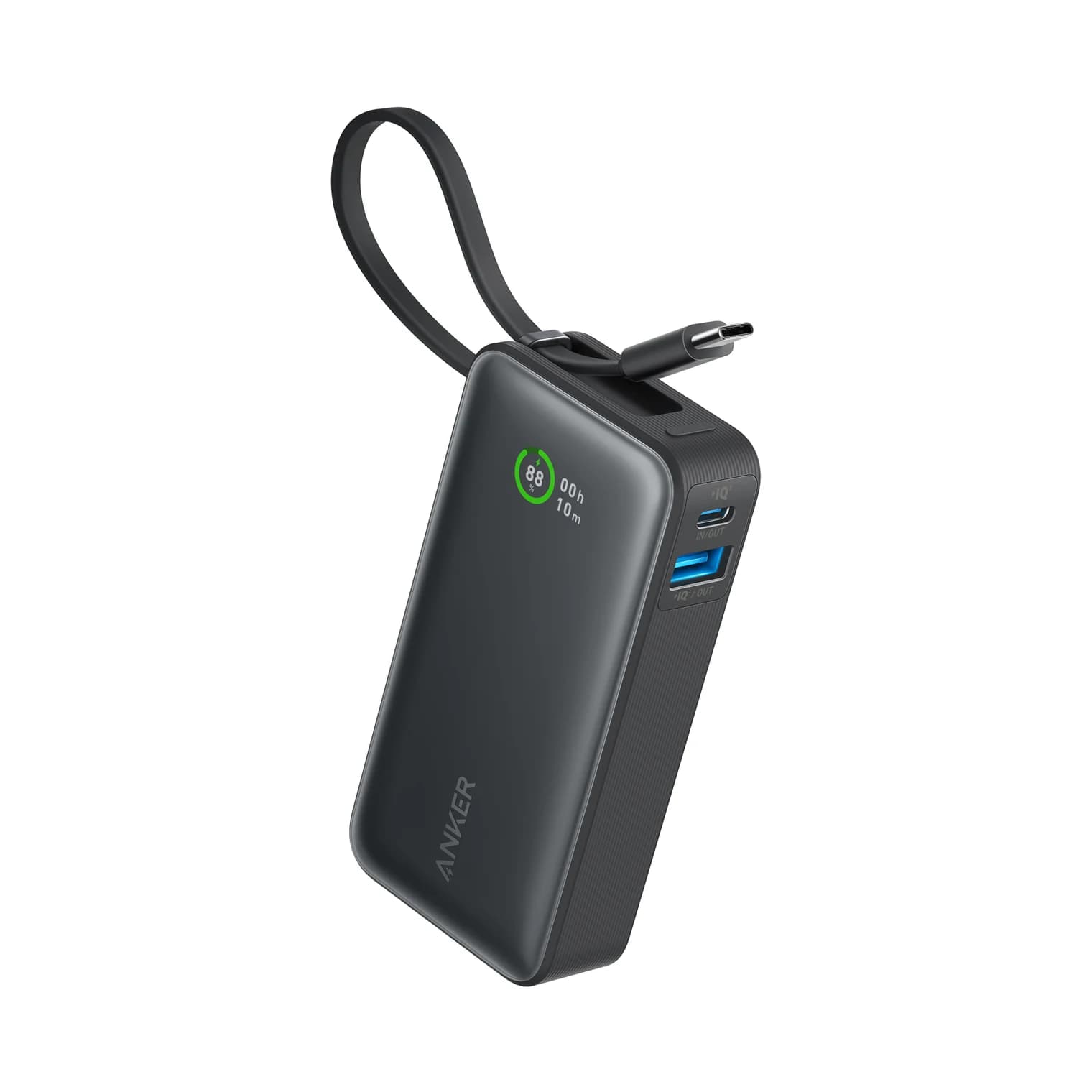
Best overall wired pickAnker
Anker Nano Power Bank (10,000mAh, 30W, Built-In USB-C Cable)
- max output
- 30W
- ports
- 3
- Choose
- Up to 30W through its built-in USB-C cable or USB-C port, plus a USB-A socket and 30W self-recharge.
- Limit
- Anker lists a lower total output figure, so expect slower speeds when charging two devices at once
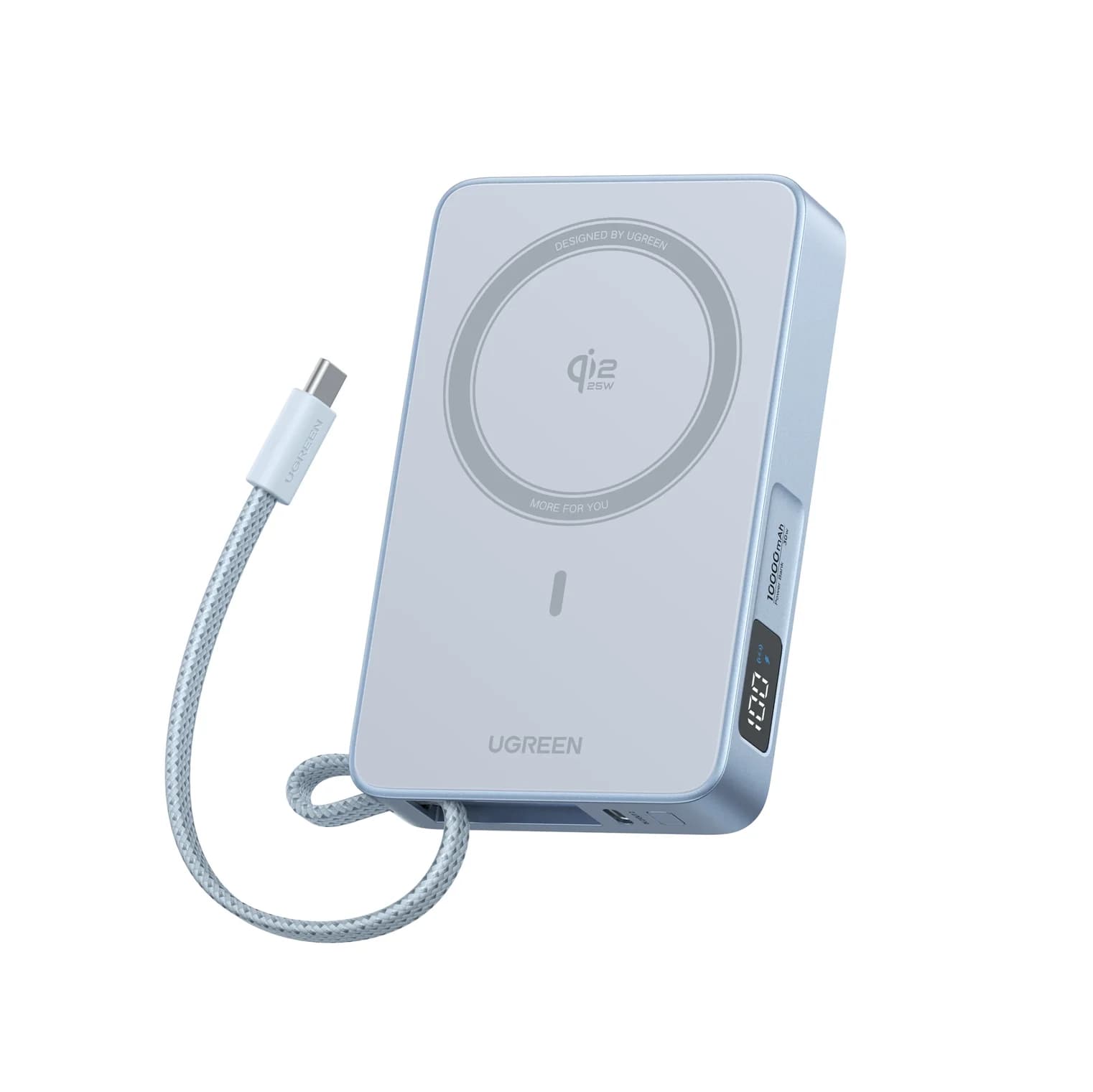
Best magnetic alternativeUGREEN
UGREEN MagFlow Magnetic Wireless Power Bank 10000mAh (Qi2 25W)
- max output
- 30W
- ports
- 2
- Choose
- Qi2 25W certified magnetic charging plus a built-in 30W USB-C cable for wired charging.
- Limit
- iPhone 12-15 models are limited to 15W wireless
Short answer: the Anker Nano Power Bank 10K (30W, built-in USB-C cable) is the better power bank for most iPhone owners — it fast-charges iPhone 15 and iPhone 16 at Apple's listed USB-C speed, though it is below Apple's 40W iPhone 17 and 60W AVS iPhone 18 Pro tiers, and it carries three ports while recharging at 30W. The Belkin BoostCharge 10K with integrated USB-C cable is the pick if pass-through charging matters more than speed: it is the only one of the two that officially lets one outlet refill the bank and your phone at the same time. And if you actually wanted a magnetic power bank rather than a wired one, the pick is neither of these — it is the UGREEN MagFlow 10K, which is Qi2 25W certified.
- 30WAnker Nano max output, built-in cable or USB-C port
- 20WBelkin BoostCharge max single-device output
- 15WBelkin's shared ceiling across two devices
- 24WAnker's total across all three ports
Both banks solve the same everyday problem — a pocketable 10,000mAh battery with its own USB-C cable, so you never carry a separate cord. They diverge on charging speed, port count, and pass-through. Below is the full comparison, plus where the magnetic Qi2 alternative fits.
Quick picks
| Pick | Product | Why |
|---|---|---|
| Best overall wired pick | Anker Nano Power Bank 10K (A1259) | 30W to one device, USB-C + USB-A sockets, self-recharge at 30W |
| Best for pass-through and simplicity | Belkin BoostCharge 10K (BPB021, integrated cable) | Officially listed pass-through power, one cable and one socket, 20W |
| Best magnetic alternative | UGREEN MagFlow 10K | Qi2 25W wireless with magnetic grip, plus a 30W built-in USB-C cable |
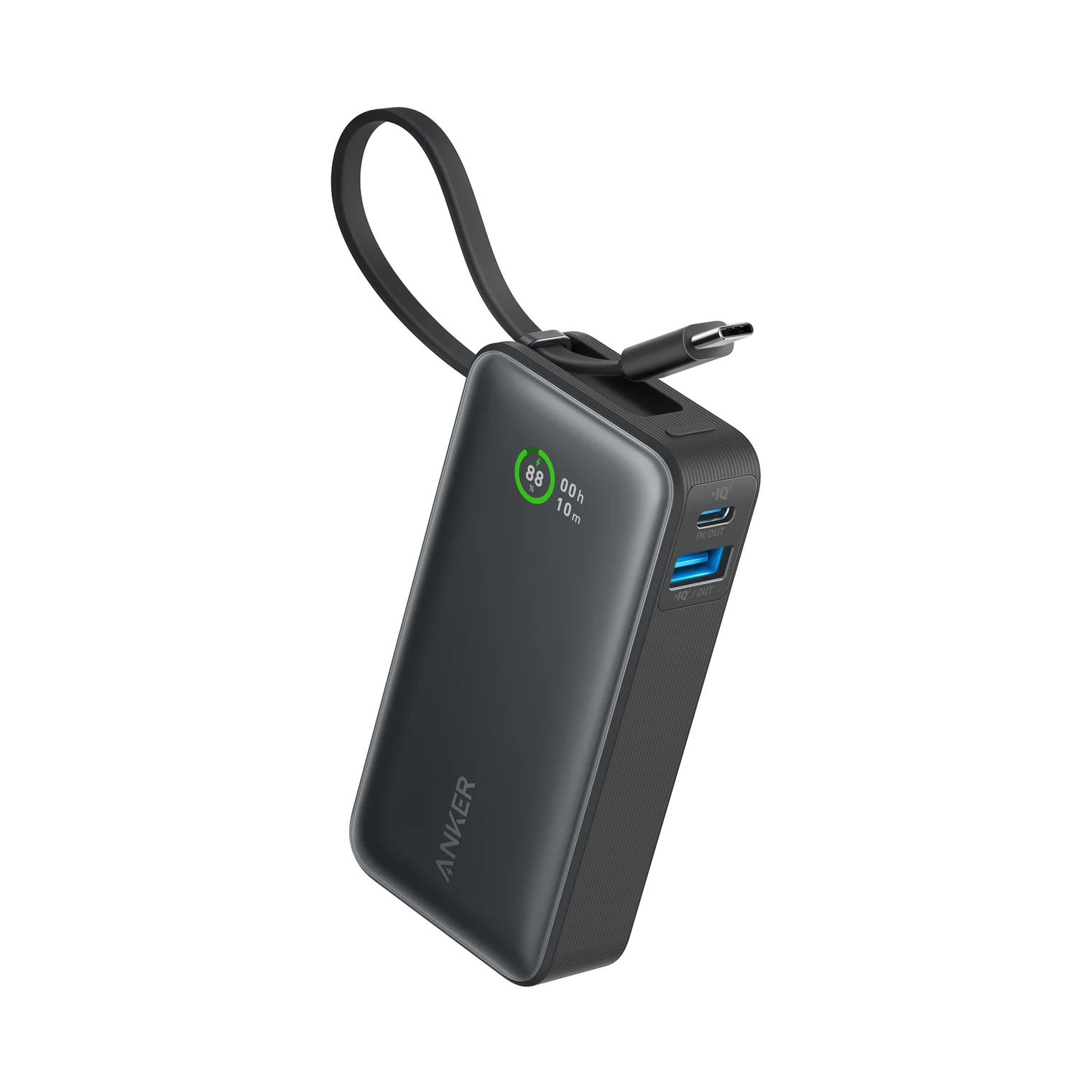
The Anker Nano Power Bank 10K (A1259)
Anker
Anker Nano Power Bank (10,000mAh, 30W, Built-In USB-C Cable)
A 10,000mAh power bank with a built-in USB-C cable plus separate USB-C and USB-A ports, rated up to 30W.
- 30W max output
- 3 ports
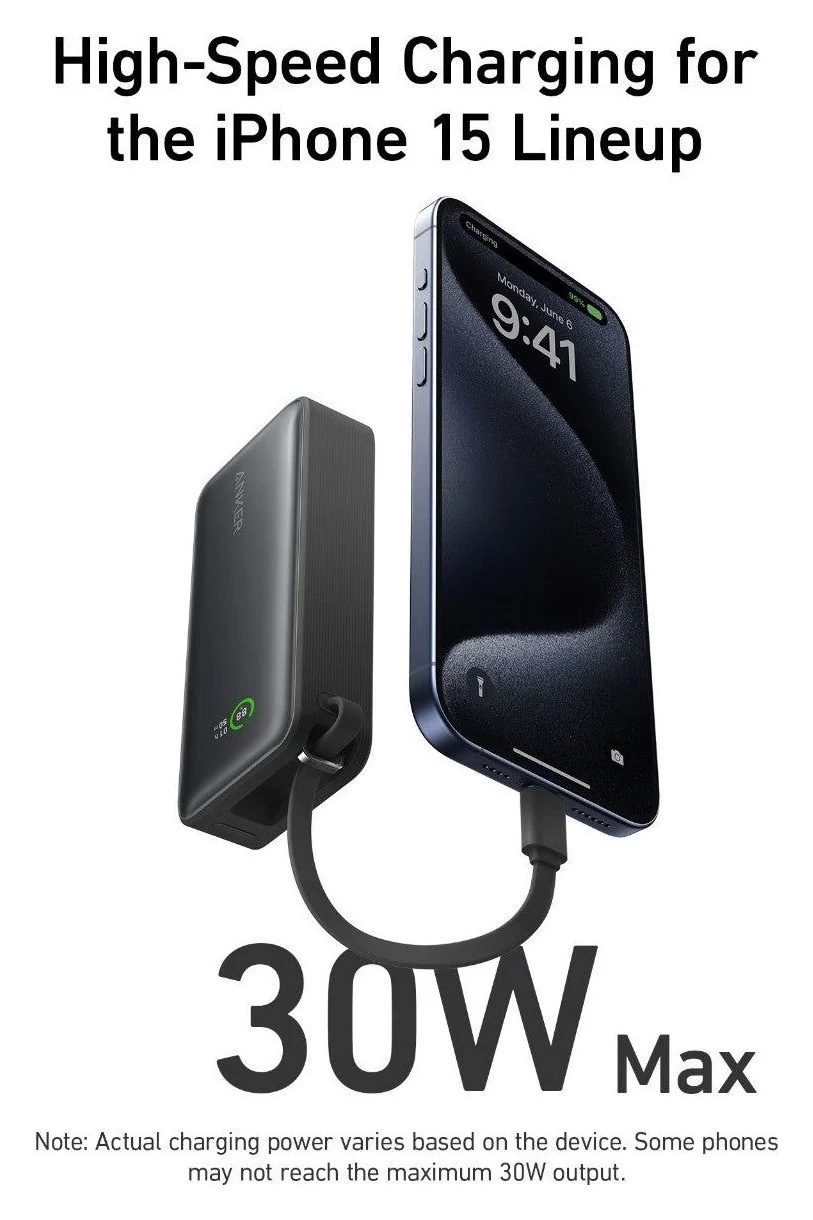
The A1259 is Anker's cable-onboard answer to the "best power bank for iPhone" question. Its built-in USB-C cable delivers up to 30W, which covers Apple's 20W fast-charge tier for iPhone 15 and 16 while falling short of the 40W and 60W tiers newer iPhones list. Beside the cable you get a USB-C socket (30W max single port) and a USB-A socket rated at 22.5W — useful for an older cable or a small accessory. Run everything at once and the bank's total output tops out at 24W, so devices share rather than each hitting their ceiling.
Input is the same story: the USB-C socket takes up to 30W, and Anker says the bank itself returns to 50% in 45 minutes. The cable doubles as a carry handle, and a color display shows charge state. At 104 × 52.3 × 26 mm and 215 g it is a jacket-pocket device rather than a jeans-pocket one.
The trade-offs: the US product page makes no pass-through claim, so plan to recharge the bank and your phone separately, and the 22.5W USB-A figure only applies to that one port.
The Belkin BoostCharge 10K (BPB021)
The Belkin plays a different game: fewer ports, lower watts, one feature the Anker doesn't officially offer. Its single USB-C socket and integrated 5.7 cm USB-C cable each deliver up to 20W when used alone (9V, 2.22A), dropping to a 5V/3A — 15W total — shared budget when you plug in two devices. Input is 20W through either the socket or the attached cable, so the bank refills with the same cord it charges with.
The headline feature is pass-through power: Belkin states the bank charges a device while the power bank itself recharges. That makes it a tidy nightstand setup — one 20W-plus wall adapter, phone and bank both full by morning. Belkin also pairs it with a 2-year warranty and a Connected Equipment Warranty of 2,500 USD.
The trade-offs are real: 20W meets Apple's fast-charge floor for iPhone 15 and 16 but not the higher tiers newer models support, two devices share just 15W, and the 2.2-inch attached cable is shorter than the Anker's. The LED indicator shows charge state but there is no display. If you are comparing within the Belkin family, our Belkin BoostCharge 10K versions guide breaks down the other models.
Head-to-head
| Spec | Anker Nano 10K (A1259) | Belkin BoostCharge 10K (BPB021) |
|---|---|---|
| Capacity | 10,000mAh | 10,000mAh |
| Max single-device output | 30W (built-in cable or USB-C port) | 20W (cable or USB-C socket) |
| Ports | Built-in USB-C cable, USB-C, USB-A (22.5W) | Built-in USB-C cable, USB-C socket |
| Two devices | 24W total across ports | 15W shared (5V/3A) |
| Recharge input | 30W max, USB-C | 20W max, USB-C socket or attached cable |
| Pass-through charging | Not documented on the US page | Supported |
| Size | 104 × 52.3 × 26 mm | 3.9 × 2.5 × 0.9 in (9.9 × 6.4 × 2.3 cm) |
| Weight | 215 g (7.58 oz) | — |
| Battery display | Color display | LED indicator |
Source: Anker A1259 product page; Belkin BPB021 FAQ; UGREEN MagFlow product page
Speed by iPhone generation
Because Apple's spec sheets state each model's fast-charge requirements, you can map these banks onto your phone directly:
| iPhone | Apple's fast-charge claim | With the Anker (30W) | With the Belkin (20W) |
|---|---|---|---|
| iPhone 15 | Up to 50% in around 30 minutes with a 20W adapter or higher | Full speed | Full speed |
| iPhone 16 | Up to 50% in around 30 minutes with a 20W adapter or higher | Full speed | Full speed |
| iPhone 17 | Up to 50% in 20 minutes with a 40W adapter or higher | Faster than 20W, below Apple's 40W tier | Slower than Apple's tier |
| iPhone 18 Pro | Up to 50% in around 15 minutes with a 60W adapter with Adjustable Voltage Supply | Partial credit — below Apple's 60W tier | Below Apple's tier |
Two readings of that table: if you own an iPhone 15 or 16, either bank fast-charges your phone to Apple's spec, and the Belkin's pass-through may decide it. If you own a 17 or 18 Pro, the Anker's 30W is the closer match — and note the iPhone 16e, which works with Qi chargers but not MagSafe or Qi2, is a wired-only customer anyway.
The magnetic question: neither of these is one
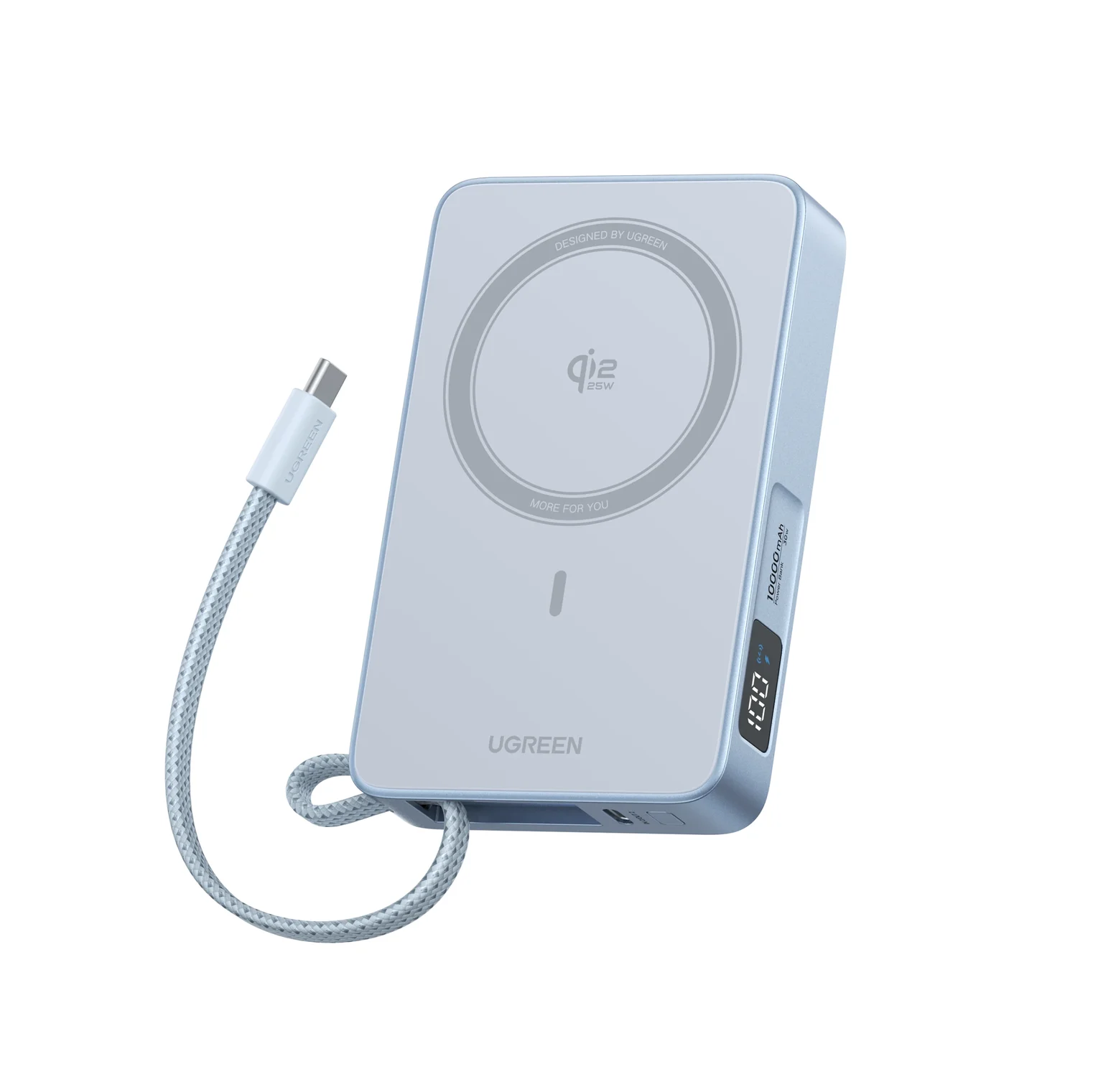
Searches for a magnetic power bank or a Qi2 2 power bank at 25W lead to a different product class. Both banks in this comparison are wired-only — Belkin's FAQ says outright that the BPB021 does not support wireless charging, and the Anker A1259's page is a USB-A/USB-C/cable affair with no magnetic claims.
If you want magnetic Qi2 charging instead
- Qi2 25W certified wireless charging with a magnetic grip — UGREEN MagFlow 10K
- A 30W built-in USB-C cable that doubles as a carry strap — UGREEN MagFlow 10K
- Up to three devices at once — UGREEN MagFlow 10K
- Wireless charging of any kind — Anker Nano 10K: no
- Wireless charging of any kind — Belkin BoostCharge 10K: no
Source: UGREEN MagFlow product page; Belkin BPB021 FAQ
The UGREEN MagFlow 10K is the one that covers both worlds: Qi2 2 at up to 25W for a magnetic snap-on charge, plus a built-in USB-C cable charging at 30W, on a 10,000mAh cell (with a stated rated capacity of 5,600mAh). An iPhone 16 or later supports 25W MagSafe/Qi2, so it keeps up with the phone's wireless ceiling. Our MagSafe power bank guide covers the category in depth.
What 10,000mAh actually gets you
Both banks advertise 10,000mAh, and both are honest about it in the fine print. The number is cell-level charge, not delivered energy. Anker's support documentation explains the arithmetic: both the conversion through the power bank's internal circuitry and the conversion within the device typically run at about 82% efficiency. That is why a 10,000mAh bank does not deliver its full headline capacity, and why the practical guidance is to compare watt-hours rather than mAh alone.
Belkin's product page carries the same disclaimer: the BPB021 "contains a 10,000 mAh internal battery" and "amount of discharge to user's device is less and may vary." Expect one to two full iPhone charges depending on your model: roughly two for smaller-battery phones and one plus a top-up for larger Pro Max models. UGREEN is the most explicit of the three, printing a 5,600mAh rated capacity alongside the 10,000mAh cell figure.
Pocket and kit considerations
- Cable duty: both attached cables charge devices and recharge the bank. Belkin's is 2.2 inches; Anker's doubles as a handle. If the cable matters, the handle is the more comfortable daily carry.
- Weight and size: the Anker is a stated 215 g at 104 × 52.3 × 26 mm; the Belkin is a slightly smaller 3.9 × 2.5 × 0.9 in footprint with no published weight. Neither disappears into a jeans pocket; both are fine in a jacket, bag, or travel kit.
- Kit cost of ownership: Belkin's box is the power bank, quick start guide, and regulatory information, with no wall adapter. The Anker US page does not publish complete box contents, so confirm that package before purchase. Add whatever USB-C adapter you already own; a 30W-or-better one suits the Anker, 20W covers the Belkin.
- Avoid name-only listings: with Belkin selling several BoostCharge 10K variants, buy by the exact SKU (BPB021fqBK for the black integrated-cable model) rather than the marketing name. The same caution applies to Anker's "Nano" line, which spans several wattages.
How we choose
We compare only what manufacturers officially state — product pages, spec sheets, and support documentation from Anker, Belkin, UGREEN, and Apple — and we cite the source behind every number in this guide. We do not repeat charge-time marketing figures that carry an internal-lab footnote, we do not rank on price (check the current price at the links above), and we flag where a spec simply is not documented, like the Anker's pass-through behavior.
Verdict
For most people searching for the best power bank for an iPhone, the Anker Nano 10K is the stronger buy: 30W wired speed that meets Apple's 20W fast-charge tier while getting closer to its higher 40W and 60W tiers, three ports for a family of devices, and a 30W self-recharge. Choose the Belkin BoostCharge 10K when its one unique feature — pass-through power — fits your routine, or when you find it meaningfully cheaper. And if you arrived here hoping for magnets, skip both and get the Qi2 25W UGREEN MagFlow 10K. For more options, see our best power banks roundup and, if you fly, our power bank on a plane rules.
Frequently asked questions
{{faq:pin}}
Frequently asked questions
Which is better for an iPhone, the Anker Nano 10K or the Belkin BoostCharge 10K?
For charging speed and port flexibility, the Anker Nano 10K is the better pick for most people: it delivers 30W from its built-in USB-C cable or its USB-C port, so a modern iPhone fast-charges at full rate, and a USB-A socket covers older gear. The Belkin BoostCharge 10K tops out at 20W and shares just 15W across two devices, but it is the only one of the two that officially supports pass-through charging, which matters if you want one outlet to refill the bank and your phone overnight.
Does either of these support magnetic or Qi2 charging?
No. Both the Anker Nano 10K (A1259) and the Belkin BoostCharge 10K (BPB021) are strictly wired power banks. If you want a magnetic Qi2 2 bank at 25W, look at the UGREEN MagFlow 10K instead — it is Qi2 25W certified and adds a 30W built-in USB-C cable alongside the magnetic pad.
Is 10,000mAh enough to fully charge an iPhone?
Usually one to two full charges, depending on your iPhone model. A 10,000mAh cell holds roughly 37 watt-hours at the cell's 3.7V nominal voltage, and conversion losses reduce what reaches the phone. Anker's support documentation gives about 82% efficiency for both the power bank's internal circuitry and the device-side conversion. Belkin's page likewise footnotes that "amount of discharge to user's device is less and may vary."
Can the Belkin recharge itself and charge my phone at the same time?
Yes. Belkin lists pass-through power for the BPB021, so one wall charger can feed the bank and a connected device at once. The Anker A1259's US product page makes no pass-through claim, so we would not rely on it for that.
Will these fast-charge the newest iPhones?
Yes. Apple's documentation calls for an 18W or greater adapter for iPhone 15 or later; its iPhone 16 specification page uses a 20W-or-higher example. The newest tiers are higher: a 40W adapter for iPhone 17's fastest 50% in 20 minutes and a 60W Adjustable Voltage Supply adapter for iPhone 18 Pro's 50% in around 15 minutes. The Anker's 30W ceiling covers Apple's 20W fast-charge tier but not its 40W or 60W AVS tiers; the Belkin's 20W meets the iPhone 15/16 threshold but leaves the 17 and 18 Pro speeds on the table.
Are these allowed on planes?
Yes. Both fall well under the 100Wh lithium limit airlines apply to carry-on batteries — the usual first question is battery size, and a 10,000mAh / roughly 37Wh cell clears it comfortably. Keep the bank with you in the cabin and check your carrier's rules for anything larger.
Related guides
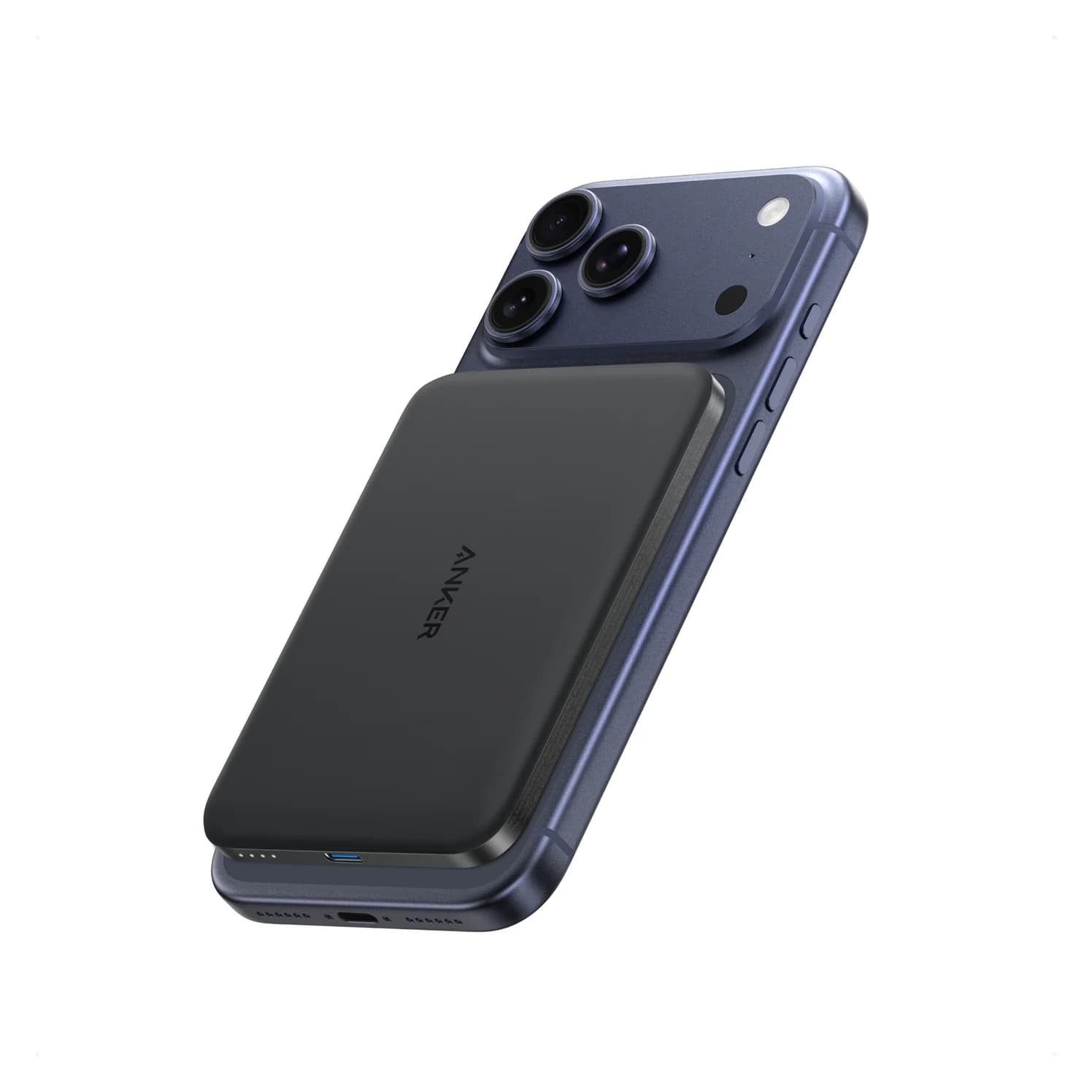
Baseus PicoGo Qi2 5K vs UGREEN MagFlow 5K: The Honest Answer in 2026
No UGREEN MagFlow 5K exists — the real Qi2 5K showdown is Baseus PicoGo vs Belkin BoostCharge Pro 10K. Here are the picks, specs, and gotchas.
Updated November 5, 2026Read
Anker Zolo 10K Power Bank Review: A1688 vs the Nano 10K
Anker Zolo 10K vs Nano 10K: compare built-in cable length, 30W charging, shared output, refill speed and the complete kit, from the makers' own documents.
Updated November 5, 2026Read
Anker Nano MagGo Slim 5K vs UGREEN MagFlow 10K: Which Magnetic Power Bank?
The Anker MagGo Slim 5K is the 8.6 mm pocket card; the UGREEN MagFlow 10K adds Qi2 25W and a built-in cable. Exact specs, phone fit and honest capacity.
Updated November 5, 2026Read